1. Start with the flat pattern, then choose sheet width and length
Nest the flat outline that will actually be cut. A bent bracket's finished length, width and height do not replace its developed dimensions. If bend compensation, reliefs, trimming allowances or the hole-layout revision remain unconfirmed, the nest is only an estimate. When comparing two stock sizes, do not also change thickness, shrink the part or omit appearance requirements and attribute the entire difference to a better sheet size.
Catalogue width ranges are a starting point for purchasing enquiries. Grade, thickness, delivery condition, edge condition and the specific production route may have different supply provisions. Obtain the sizes available for this order, dimensional tolerances and weight basis, then give the usable area to the nesting planner. Do not combine maximum widths from different product rows into a universal supply table.
A sheet area larger than the combined part area does not prove that the parts fit. Shape compatibility, permitted rotations and clearance between the sheet edge and parts determine whether the remaining region can accommodate another part.
2. What changes with full sheets, slitting and cut-to-length stock?
A full sheet is a purchasing and machine-loading unit. Slitting mainly changes coil width; cutting to length mainly changes length. These routes can be combined: wide coil can be slit and then cut into sheets, while slit coil can feed a compatible downstream process directly.[1][2]
| Purchasing or preparation route | What can be adjusted | What the quote still needs to establish |
|---|---|---|
| Buy available full sheets, then nest and cut | Choose a width-and-length combination suited to the flat pattern | Usable dimensions, edge trimming, clamping areas, whole-sheet quantity and leftovers |
| Slit wide coil into narrower coils | Divide the parent-coil width into strips for later operations | Parent-width allocation, side trim, strip-width and edge requirements, head/tail handling, order quantity and remaining-coil ownership |
| Level coil and cut it to specified lengths | Arrange sheet lengths to suit downstream material demand | Source of the width, length and squareness requirements, flatness, head/tail losses, processing charges and supply terms |
| Nest again on suitable remnants | Use an existing suitable region | Material/batch identity, actual outline, direction, surface condition, re-clamping and retrieval cost |
A cut length close to one group of blanks does not mean finished parts are ready for delivery. Outer profiles, holes, edges and subsequent forming usually still require work. Check the shape of leveled sheet against actual requirements, using the steel-sheet cut-to-length and leveling guide where useful.
3. Define spacing before calculating the part count
“Spacing” in nesting software may refer to the gap between part contours, cutting paths or another process setting. Kerf is the width removed by cutting. The reserved space between adjacent contours must also suit the cutting method, support and stability requirements. If an agreed contour gap already includes these effects, do not mechanically add kerf again.[3]
Similarly, edge margins may cover original-edge condition, clamping or location as well as kerf. Lead-ins, lead-outs, piercing, microjoints and cutting sequence still need confirmation in the actual process. The grid example below only compares material arrangements under its stated inputs.
Illustrative calculation: assume the approved flat blank is a solid rectangle without holes, measuring 300 mm across the sheet width and 400 mm along its length. All parts keep the same orientation, without rotation. Each edge margin is e = 10 mm and the gap between adjacent finished contours is g = 5 mm. This example treats that gap as the combined process allowance and does not add kerf separately. Material, 2 mm thickness and surface requirements are identical. Both 10 mm and 5 mm are teaching inputs, not universal processing settings.
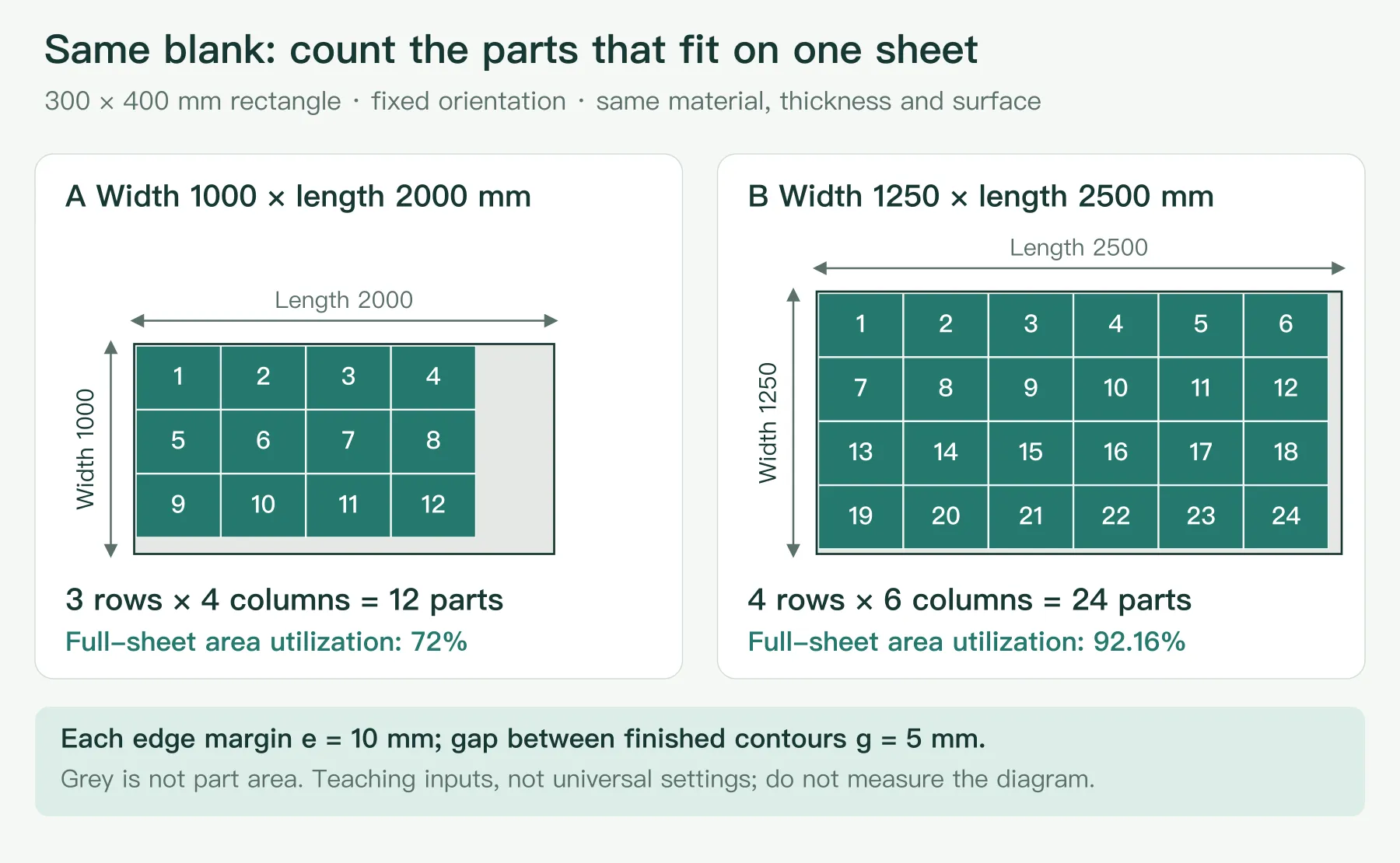
For this fixed-orientation rectangular grid, the across-width count nᵥ satisfies nᵥ×300 + (nᵥ−1)×g + 2e ≤ sheet width; the along-length count nₗ satisfies nₗ×400 + (nₗ−1)×g + 2e ≤ sheet length. Take the largest integer satisfying each condition and multiply them for the number of parts per sheet. This grid method does not establish an optimum for mixed irregular shapes.
Stock A is 1000 × 2000 mm: the width requirement is 3×300 + 2×5 + 20 = 930 mm, and the length requirement is 4×400 + 3×5 + 20 = 1635 mm, giving 12 parts. For stock B at 1250 × 2500 mm, the corresponding requirements are 1235 mm and 2445 mm, giving 24 parts.
Each blank has area 0.300×0.400 = 0.12 m². Using total blank area divided by purchased sheet area, A's full-sheet utilization is 12×0.12÷2 = 72%; B's is 24×0.12÷3.125 = 92.16%. These figures apply only to the solid rectangle in this example. Where real parts have holes, utilization based on bounding rectangles must not be presented as net-part utilization.
4. Changing order quantity can reverse the purchasing result
Full-sheet utilization describes a filled sheet. The number of sheets needed for an order also depends on how much of the final sheet is used. To show the difference, assume each order uses only A or only B, purchases whole sheets, makes exactly the ordered quantity and has no rejected parts. Exclude remnant credits and sharing stock with other orders.
Assume calculation density ρ = 7850 kg/m³ and uniform thickness t = 0.002 m. The theoretical mass per square metre is ρt = 15.7 kg/m², making each A sheet 31.4 kg and each B sheet 49.0625 kg. Actual settlement must follow the contractual weight basis.
| Comparison | A: 1000 × 2000 mm | B: 1250 × 2500 mm | How to read the result |
|---|---|---|---|
| Capacity of a filled sheet | 12 parts | 24 parts | Same orientation, margins and gap |
| Full-sheet utilization | 72% | 92.16% | Both denominators use whole-sheet area |
| Sheets purchased for 48 parts | 4 sheets | 2 sheets | Both orders exactly fill their nesting capacity |
| Theoretical mass purchased for 48 parts | 125.6 kg | 98.125 kg | B requires less purchased mass under these assumptions |
| Sheets purchased for 25 parts | 3 sheets | 2 sheets | The last sheet makes 1 part in either case; unused capacity is not delivered quantity |
| Theoretical mass purchased for 25 parts | 94.2 kg | 98.125 kg | A instead requires less purchased mass for the whole order |
| Order-area utilization for 25 parts | 25×0.12÷6 = 50% | 25×0.12÷6.25 = 48% | Area unused by this order remains in the denominator |
This table does not determine the final part price. Even at the same material price per kilogram, slitting, cutting to length, cutting, handling and storage costs must be compared. If mixed stock sizes or nesting with other confirmed orders are allowed, prepare another layout. Possible future demand is not material already consumed by this order.
5. Record reusable remnants, scrap and cutting losses separately
Do not treat every leftover as scrap steel, or value every leftover as an asset at its original purchase price. A sufficiently large remnant has identifiable reuse value only when material and heat/batch identity remain available, surface and flatness are suitable, its actual outline can be located, and a later order can genuinely use it. Storage, retrieval and re-clamping also cost money.[4]
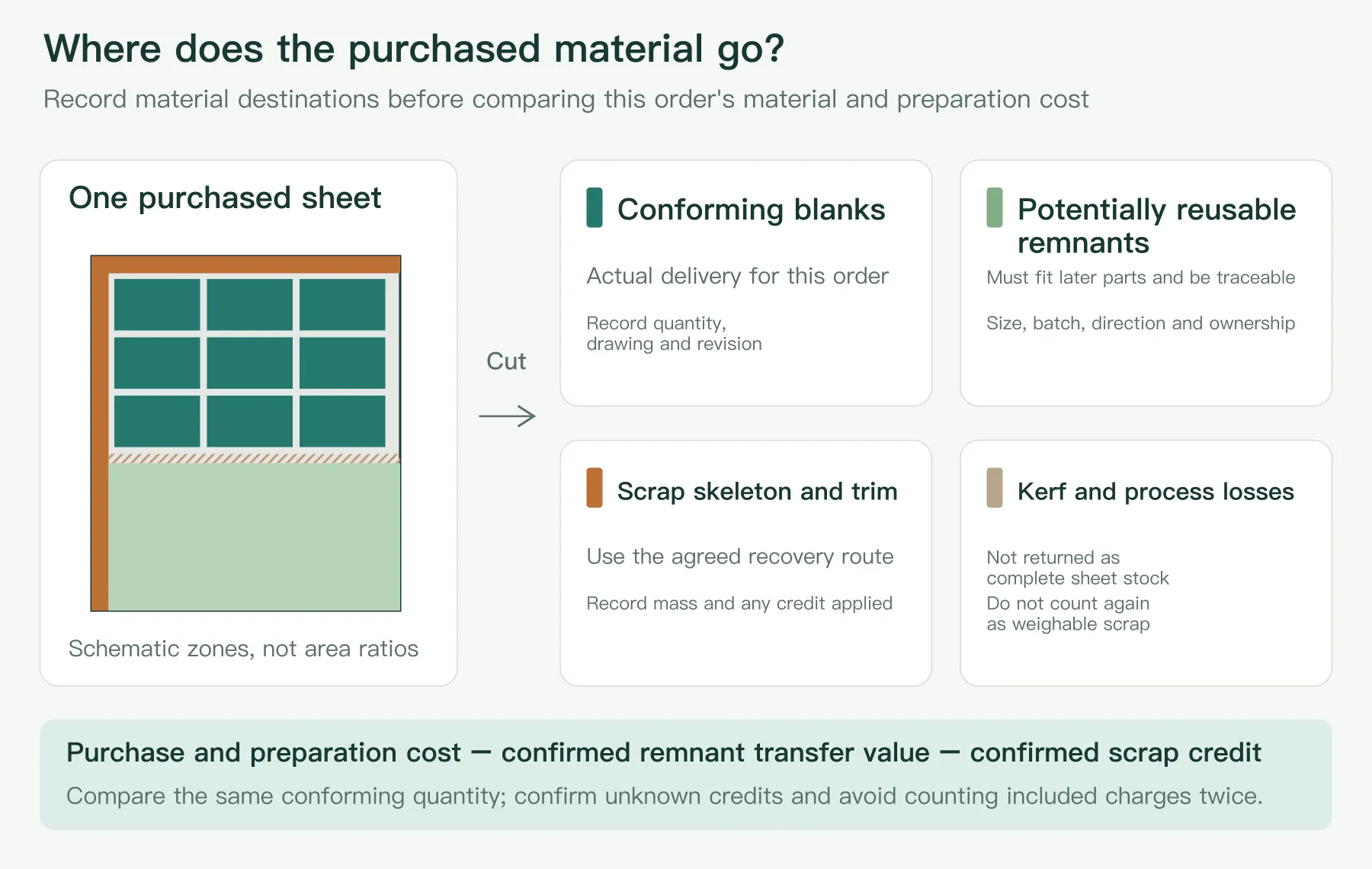
For quotation comparison, one consistent basis is: order material and preparation cost = purchasing cost + agreed slitting/cut-to-length/handling charges − confirmed remnant transfer value − confirmed scrap-recovery credit. Divide by the same number of conforming delivered parts. If the purchase price already includes an operation, or the supplier already credited scrap value, do not add or subtract it again.
This is a comparison method, not a request for suppliers to reveal every cost. Establish whether the quote charges full sheets, net consumption or another basis, who stores and owns remnants, and whether a later order may receive a credit. Where these terms are unknown, initially estimate with no credit and list the open questions.
6. A tighter nest still needs a workable cutting process
Rotating parts may change the count, but rolling direction, brushed texture, protective-film orientation or assembly appearance may restrict rotation. Do not delete a drawing's direction requirement to fit one extra part. Professional nesting systems also use orientation and equipment constraints as inputs.[3][5]
Common-line cutting, nesting inside openings and smaller gaps require review for the selected cutting process. Part support, cut-part tipping, heat and sequence can affect dimensions and stability; SSAB's thermal-cutting guidance for its steels specifically addresses nesting and cutting order.[6] A higher area-utilization figure cannot replace process confirmation. See the laser-cut sheet warping guide for checks after unclamping.
7. Give both quotations the same inputs
You do not need to settle on the best sheet width before enquiring. Give suppliers the same part information and ask them to identify available stock sizes, nesting assumptions and purchasing quantities for the whole order.
| Information to provide or confirm | What to specify | Records to retain for comparison |
|---|---|---|
| Part and revision | Flat outline, trimming allowance and holes; mark unresolved items | Controlled drawing and nesting-layout revisions |
| Material conditions | Grade, delivery condition, thickness/tolerance, surface and certificate requirements | Specific supply sizes and permitted substitutions |
| Direction and usable area | Rolling or texture direction, allowed rotations, edge and clamping allowances | Nest orientation and definitions of margin and gap |
| Quantity and schedule | Required conforming quantity and split deliveries; distinguish forecasts from orders | Sheet count, planned parts per sheet and final-sheet treatment |
| Pricing and remnants | Theoretical or actual mass, included preparation charges, remnant and scrap ownership | Quotes with the same cost scope and credit conditions |
If no flat pattern is available, send a part drawing, sketch or photograph and explain its use, expected quantity and appearance-direction requirements. Starting with these conditions makes the alternatives easier to compare than simply asking whether large or small sheets are cheaper.
- [1] Kloeckner Metals — Slitting: the basic coil-slitting process.
- [2] Kloeckner Metals — Cut to Length: distinctions between cut-to-length stock, blanks and shearing.
- [3] TRUMPF TecZone documentation — Nesting: orientation, support, part spacing and common-line nesting conditions.
- [4] Lantek — Intelligent remnant handling: remnant identification, handling, storage and reuse.
- [5] Lantek — Software for linear cutting with shears: rectangular nesting, orientation and equipment limits.
- [6] SSAB — Planning and preparation: nesting and sequence guidance for thermal cutting of SSAB steels.