The word sandblasting does not prove that natural sand is used. This guide uses abrasive blasting for cleaning or surface modification, and shot peening for controlled mechanical treatment. A drawing should identify the intended process in English as well as the required outcome.
Three names that should not be merged
Abrasive blasting is the broad process of propelling a selected medium at a surface to clean it or change its condition. The medium may be mineral abrasive, aluminum oxide, glass beads or metal shot. The common term sandblasting does not identify the medium, the process setting or the acceptance criterion. [1]
Shot blasting commonly describes blasting with shot to remove scale or contamination, create texture or prepare for another operation. Shot peening describes a controlled process whose target is plastic deformation and a beneficial compressive residual-stress state near the surface. Workshop names can overlap, so the drawing should state the English process name, the treated area and the intended result. [2]
Using steel shot to clean a weld does not, by itself, qualify the part as shot peened. Conversely, specifying glass beads does not prove that the required peening state has been achieved. [1][2]
What actually changes at the surface?
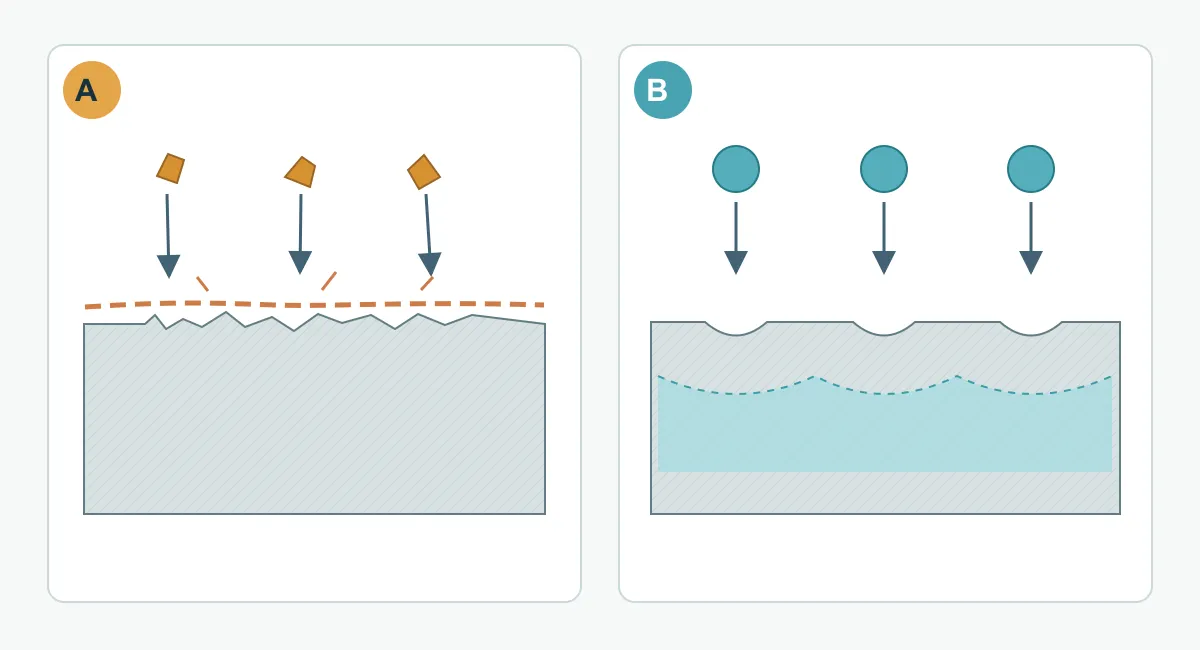
For coating preparation, the blasting result is a surface with a specified level of cleanliness and profile. Suitable media can remove scale, rust or old coating and change appearance or texture. A rough feel is not proof that oil or other contamination is gone, and roughness alone does not establish coating adhesion. The profile measurement method and target must come from the selected coating system or job specification. [1][3]
In controlled shot peening, repeated impacts create small plastic indentations and a compressive residual-stress layer. This can help a part when fatigue cracks would otherwise initiate at its surface. The actual benefit still depends on material, existing defects, geometry, loading and a qualified process. Peening cannot repair an existing crack or guarantee service life. [2]
The mechanisms are not exclusive. Abrasive blasting can also affect residual stress; peening can change roughness, remove some high points and distort thin or close-tolerance parts. Judge the operation by its defined purpose and inspected result, not by a photograph or the machine alone. [1][2]
| Question | Abrasive blasting for cleaning or profile | Controlled shot peening |
|---|---|---|
| Primary objective | Remove specified surface material or create a coating-ready surface or appearance | Establish a specified near-surface plastic deformation and compressive-stress condition |
| Typical media | Selected for substrate and goal; angular grit or glass beads are examples | Usually controlled rounded metal, ceramic or glass shot |
| What to inspect | Treated area, cleanliness, residues, profile and appearance | Treated area, intensity, coverage, media condition, masking and final dimensions |
| Do not assume | Roughness proves adhesion or fatigue improvement | Rounded shot proves peening intensity or fatigue life |
Choose by the part and its function
For a sheet-metal enclosure that will be painted or powder coated, start with the substrate, existing scale or coating, appearance and the coating supplier's requirements. If blasting is selected, define surface cleanliness, profile, contamination control and how the part is kept clean until coating. Mask threads, sealing faces, electrical contacts, locating surfaces and any area with a different cosmetic requirement. Blasting is one possible pretreatment step, not a substitute for degreasing or final coating approval. [1][3]
For a spring or other cyclically loaded component, first identify the material and heat-treatment state, load case, fatigue-critical areas and surfaces that must not be treated. If peening is appropriate, use the applicable process specification to agree intensity, coverage, media and records. Too little coverage or excessive peening can make fatigue performance worse; longer exposure is not automatically better. [2]
For thin brackets and precision fits, assess distortion, edges, holes, threads and assembly datums before either treatment. Inspect critical dimensions in the specified finished condition. [2]
What should the drawing or RFQ say?
Avoid a bare note such as “sandblast” or “shot peen as usual.” State the reason for treatment, mark the area and define how the result will be accepted. Parameters that are not known yet can be left for a documented engineering review instead of filled with a universal value.
For coating preparation, name the substrate and starting condition, the material or coating to remove, the intended coating system, treated and masked zones, cleanliness and profile methods, allowable residues, and the handling and coating sequence. Let the coating specification determine the profile target. [1][3]
For controlled peening, name the material and heat-treatment state, fatigue concern, treated and masked zones, applicable process specification, media condition, intensity with Almen strip type and saturation control, coverage, records and dimensional recheck. Almen arc height and coverage are process controls, not direct measurements of the part's residual-stress distribution or fatigue life. If performance proof is required, agree a separate verification method and acceptance criterion. [2]
Four mistakes to avoid
A process name is only useful when it leads to an inspectable requirement. Check these claims before they reach a drawing or purchase order:
- “Round steel shot means qualified peening.” Similar media and equipment can serve cleaning or peening; the latter needs controlled intensity, coverage and acceptance. [1][2]
- “A rougher surface always holds coating better.” Cleanliness, contaminants, coating chemistry and application conditions matter alongside the specified profile. [1][3]
- “Peening always extends fatigue life.” The part, loading and process window matter; insufficient or excessive treatment may harm the result. [2]
- “A peened part needs no dimensional check.” Impacts can affect appearance, shape and close fits, particularly on thin parts. [2]