1. Read the steel class, quality grade and delivery condition separately
In Q355ND, Q355 is the strength-related class identifier, N is the delivery-condition code and D is the quality grade. GB/T 1591-2018 uses N for both normalized and normalizing-rolled steel. It permits the AR or WAR code for the as-rolled condition to be omitted. That omission has a defined context; it does not make a quotation reading only “Q355 plate” a complete specification. [1]
When supply to this standard is explicit, check Q355D, Q355ND and Q355MD against their respective conditions. When “Q355” is merely a catalogue class or sales abbreviation, add the quality grade, product type, standard edition and actual delivery condition. A catalogue may put Q355N in one column and B, C, D or E in another. Copying only the first column loses part of the requirement.
The number 355 does not mean that every thickness has the same yield-strength requirement or that every test result must be exactly 355 MPa. Select the requirements for the complete designation, product and thickness, and distinguish specified limits from the measured results for the batch.
| Wording encountered | What it identifies | What still needs checking |
|---|---|---|
| Q355 alone in a catalogue or quotation | A steel-class abbreviation | Standard and edition, quality grade, product form and actual condition |
| Q355D to GB/T 1591-2018 | Quality grade D; the as-rolled code may be omitted | Thickness-dependent requirements, additional order conditions and batch evidence |
| Q355ND | N condition and quality grade D | Whether the actual route is normalizing or normalizing rolling, and whether the order restricts that choice |
| Q355MD | M condition and quality grade D | Compatibility between the offered material and subsequent fabrication |
| S355J2+AR or S355J2+N | A steel name and condition notation in another standards system | Applicable EN part, edition and product conditions; this is not a letter-by-letter conversion to a GB grade |
The EN notations +AR and +N also belong to a particular standard and product context. SSAB's Multisteel SNL information lists its available EN 10025-2 and EN 10025-3 designations separately from its normalized delivery condition. Tata's structural-steel information also separates delivery condition from cold-forming options. Similar letters do not replace a comparison of complete requirements. [2][3]
2. N covers two routes; M has a different process basis
Normalizing uses appropriate reheating and air cooling after rolling. Normalizing rolling controls the final rolling stage to achieve the corresponding normalized condition. These are different manufacturing routes: N does not automatically prove that a plate passed through a separate normalizing furnace. [1]
Thermomechanical processing combines deformation with temperature and cooling control. Rolling does more than reduce the plate to its specified thickness: it helps create the required microstructure and properties. Actual routes can include controlled cooling. TWI describes the roles of grain refinement, transformation and accelerated cooling in some TMCP routes. [4]
Q355M therefore should not be read as ordinary Q355 with an extra heat treatment. The properties created by thermomechanical rolling cannot be recreated by heat treatment alone. Reheating a plate does not reproduce its original manufacturing conditions. [5]
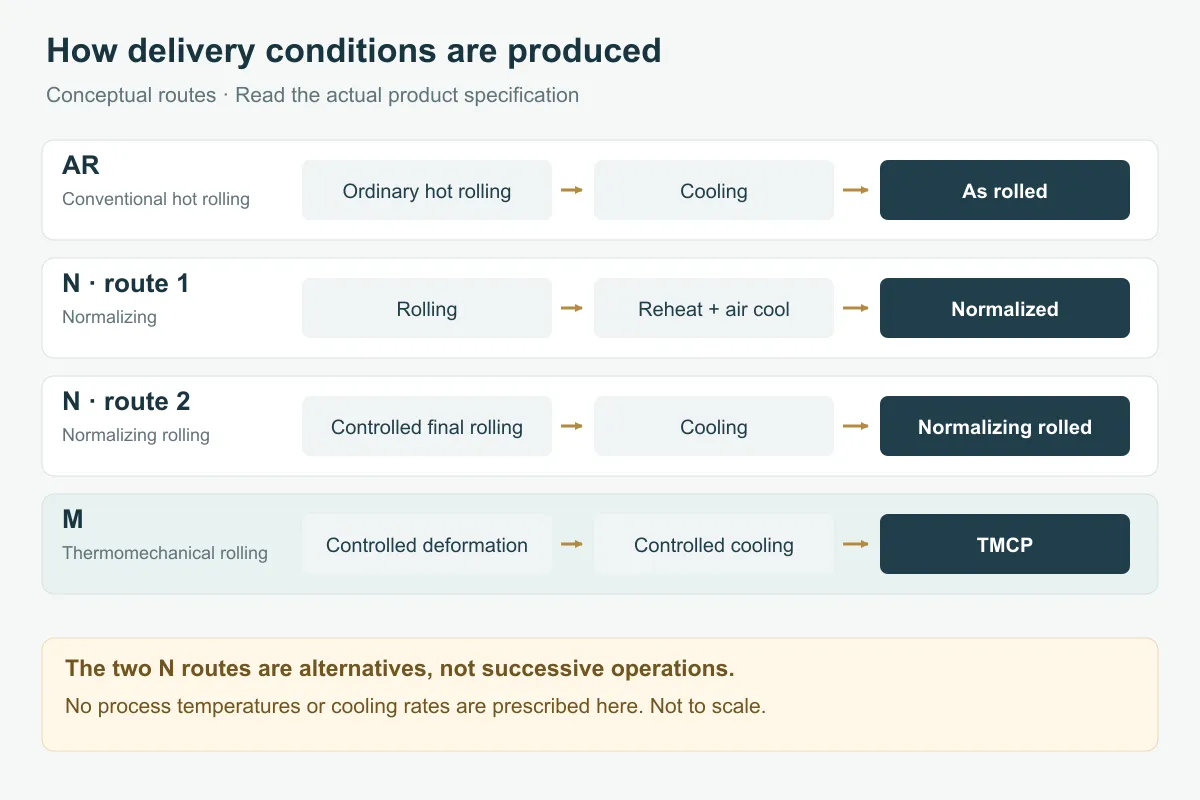
“Controlled rolling” can still be ambiguous in a supplier discussion. Ask for the specific delivery condition and its applicable definition, so that normalizing rolling and thermomechanical rolling are not treated as the same process.
3. Cold bending needs forming requirements, not just a strength class
Conformance to a material standard does not prove that a plate will make any hole-adjacent bend at any inside radius. Review thickness, bend direction, inside radius, edge condition, holes and slots, and springback requirements. Establish whether the order includes the forming performance needed for the part; N and M do not provide a universal minimum bend radius.
A supplier's bending guarantee for a particular product must retain its material condition, thickness and direction limits. SSAB lists forming conditions separately from delivery and heat-treatment information; Tata requires applicable cold-forming options to be specified at ordering. Their product-specific numbers cannot be transferred directly to another mill's Q355 steel. [2][3]
Where a trial is needed, preserve the features that make the part demanding: actual thickness, rolling direction, inside radius and any nearby holes. A generous straight bend cannot validate a small flange or a more highly strained detail. Record the plate or batch used, so that the result can be connected to the production review.
4. Welding and reheating: define what the material will experience
Welding introduces local heating and cooling around a joint. A satisfactory parent-material certificate does not settle the joint's thickness combination, welding method, consumables, preheat, interpass temperature, heat input or required inspection. These conditions must suit the actual material and applicable welding procedure; they should not be copied solely because both materials share a strength class.
TMCP steels do not all respond identically to welding. TWI explains that heat-input tolerance varies with the manufacturing route, that some materials can soften in the heat-affected zone, and that grades specifically developed for higher heat input also exist. Check the mill's guidance for the offered product and the applicable procedure qualification. A heat-input limit from one product is not a universal limit for Q355M. [6]
Include hot forming, flame straightening and post-weld heat treatment in the review before they occur. Temperature, time, cooling, heated area and previous deformation can all matter. Do not add a normalizing operation informally to “restore the material” or “remove stress,” then continue to rely on the original delivery-condition evidence. Agree whether the treatment is permitted and how the required properties will be demonstrated afterward.
| Subsequent operation | Information needed for review | Insufficient basis for release |
|---|---|---|
| Cold bending | Radius, direction, thickness, edges and holes; required forming guarantee or representative trial | Both names contain 355; one easy bend succeeded |
| Welding | Joint and thickness combination, procedure scope, mill guidance and specified inspection | Parent-metal tensile results pass; the weld looks acceptable |
| Hot forming or local straightening | Heating and cooling plan, permitted conditions, deformation and subsequent verification | “Only a little heat”; experience with another steel |
| Post-weld or whole-part heat treatment | Actual thermal cycle, material compatibility and property-verification plan | An assumption that normalizing restores every steel |
This table identifies the missing review information; it does not prescribe universal process settings. A quotation and material-candidate comparison can proceed while a heating plan is being developed. Release of the affected operation still needs an established basis.
5. The order, catalogue and certificate answer different questions
The order defines what this purchase requires. A catalogue describes available product choices. The certificate and physical identification connect those requirements to the material delivered and its inspection evidence. A catalogue listing both N and M does not make the buyer's selection. A certificate from another heat does not establish the condition of the current plates.
Record the original wording side by side, including standard editions and document references. When a certificate uses a condition abbreviation, establish its meaning in that document. “Complies with order” leaves an unresolved question if the order itself never defined the condition; an inspector should not fill that gap by guessing.
| Field | Order or controlled drawing | Catalogue or supply confirmation | Actual certificate and material |
|---|---|---|---|
| Complete material name | Grade, quality, condition and additional requirements | Is the offer complete, or have suffixes disappeared? | Does it match the agreed requirement? |
| Standard and product scope | Number, edition and product form | Applicable product and dimension range | Does this batch use the corresponding basis? |
| Delivery condition | Required condition and any route restriction | The actual proposed route, not a list of all options | Condition record, material identification and necessary supplier clarification |
| Inspection and traceability | Required documents and additional tests | Guaranteed values versus typical data | Heat/plate relationships, results and test conditions |
| Fabrication afterward | Known forming, welding and heating plans | Product guidance and its limits | Does the review cover the actual material and intended operations? |
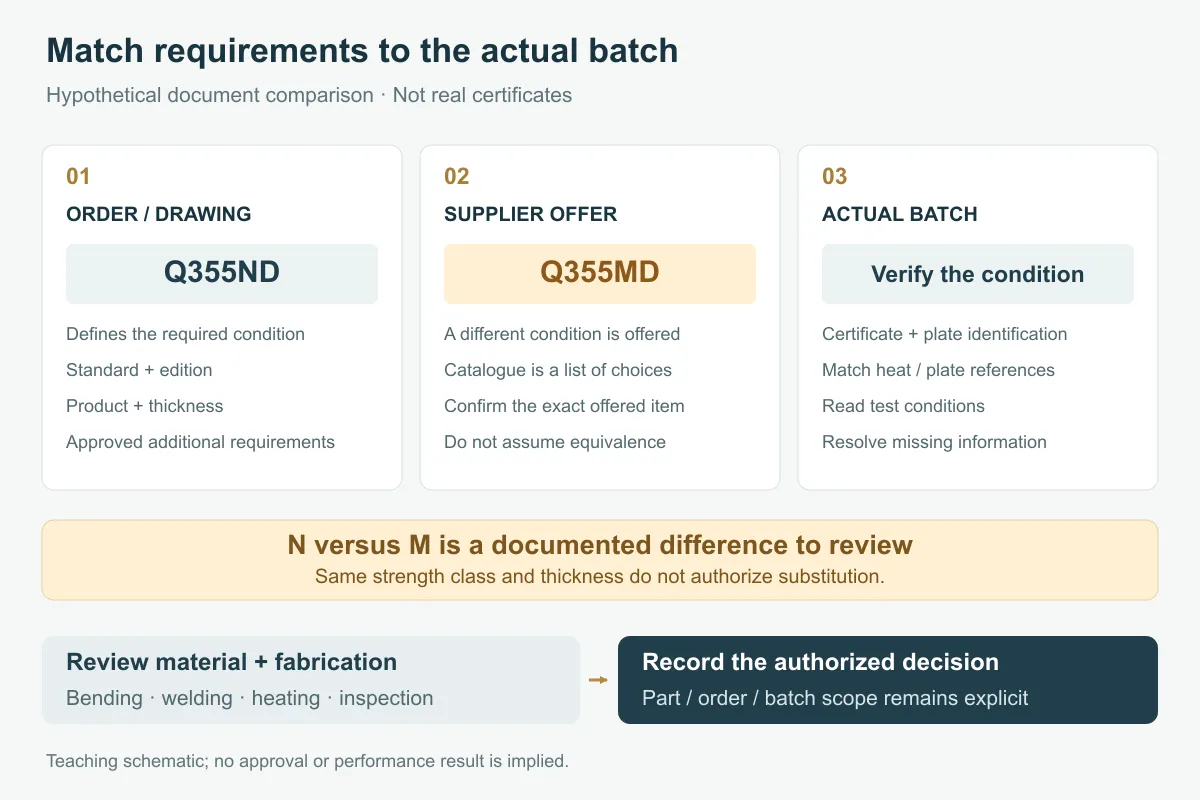
6. Hypothetical review: Q355ND ordered, Q355MD offered
Assume a welded support plate has a controlled order specifying GB/T 1591-2018 and Q355ND. The supplier offers Q355MD at the same thickness and provides a catalogue page. The part also has a proposed heating-and-straightening operation whose details are not settled. At this stage a different candidate material has been proposed; matching the class number and thickness is insufficient to approve it.
First, establish why N was specified and whether the heating operation is necessary and defined. The person responsible for the drawing or material requirement should clarify this. Purchasing should not simply remove N from the original order.
Next, obtain a complete offer, the batch certificate that can be provided, and information supporting the proposed welding and heating conditions. Compare delivery condition, composition, thickness-dependent mechanical requirements, impact-test conditions and additional inspection separately. A higher measured yield value does not resolve all the other differences.
If the supplier's evidence and fabrication review support the alternative, define the necessary trial or testing, post-processing acceptance criteria and scope of approval before an authorized person signs the change. If the heating plan remains unresolved, record that the material candidate is under review and the heating operation is not released. Keep gathering information instead of marking an unknown as compliant.
Where approval is limited to a part, order or heat, carry that scope into purchasing, material issue and inspection records. A later change of mill, delivery condition or heating plan requires a check that the original approval still applies.
7. Include the condition in the enquiry
Send the drawing, complete material designation, thickness and governing standard together. Explain whether the part will be cold bent, welded, hot formed or heat treated afterward. Mark undecided operations as “to be confirmed.” That is more useful than “Q355 or equivalent” when identifying what the quotation depends on.
If the drawing says only Q355 while suppliers offer Q355N and Q355M, provide the competing descriptions and the part's purpose, with loaded areas, bends and welds identified. These concrete details help us discuss the information needed for a quotation. The confirmed material and fabrication requirements can then become the basis for purchasing and production.
- [1] GB/T 1591-2018 status — SAMR
- [1] standard text hosted by the China Steel Construction Society
- [2] SSAB Multisteel SNL: delivery, forming and heat-treatment information
- [3] Tata Steel UK: Structural steel, delivery and cold-forming options
- [4] TWI: What are TMCP steels?
- [5] voestalpine: Thermomechanical rolling
- [6] TWI: Are TMCP steels readily weldable?