Laser-cut panels, stamped parts and valve blocks with intersecting holes can all have burrs, but they may need different ways to remove them. Start with the burr's location and whether a tool or finishing medium can reach it. Then consider the material, quantity, dimensions and surface condition that must be preserved. One part may need more than one operation: a large burr may need to be removed first, followed by finer finishing and inspection of critical features.
For an enclosure or bracket, cable openings, mating edges and self-clinching holes may also need different requirements. See Sheet Metal Deburring: How to Specify and Inspect the Right Edge.
Look at the part before choosing a tool
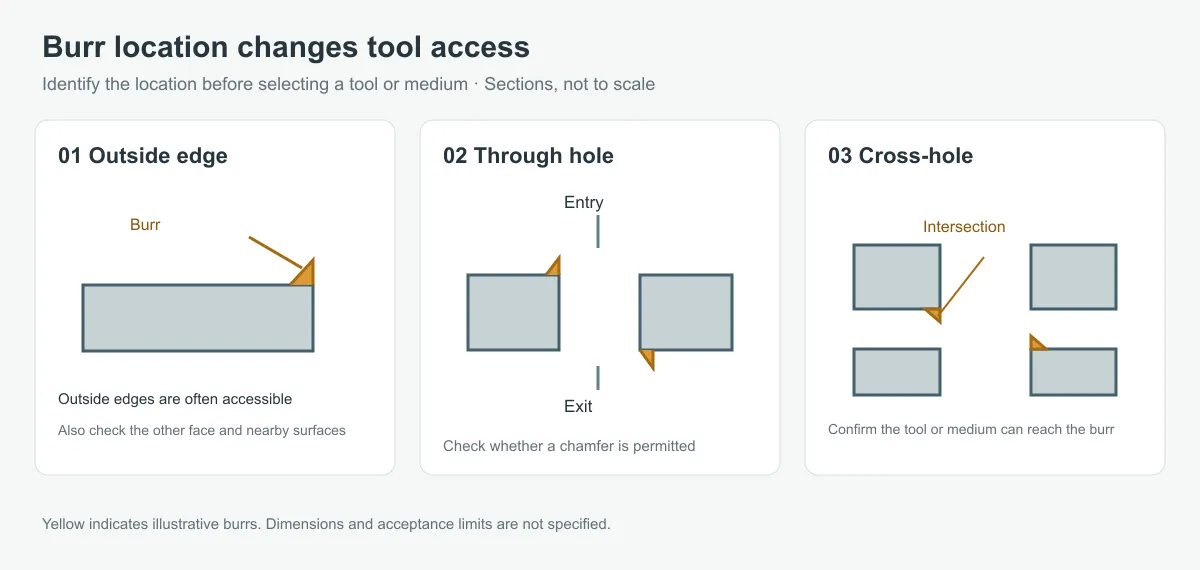
- Where is the burr? Outside edges, hole mouths and open slots are generally accessible. Cross-holes, blind-hole bottoms and the inside of a formed enclosure require a check of whether the tool or medium can actually reach the area.
- What is the burr like? A small projection and a thick, hard or continuous burr present different challenges. A heavy burr may need preliminary removal before finishing; check afterward for secondary burrs or remaining material.
- Where must material be preserved? A locating hole, sealing surface, thin tab, mating edge or hole with a specific installation requirement may not tolerate the same treatment as the outside perimeter. Follow the selected fastener's instructions for its mounting holes.
- What result is required? Removing a projection, breaking a sharp edge, creating a specified chamfer or radius, and improving surface appearance are different requirements. A single operation can address more than one, but “deburr” alone does not specify a radius or surface roughness. [1][2]
Comparing common deburring methods
This table narrows the choices. The result depends on the tool, media, settings, part geometry and incoming burr condition; the process name alone does not establish acceptance.
| Method | When to consider it | What to check before selection |
|---|---|---|
| Hand filing, scraping or sanding | Prototypes, small quantities or accessible local edges | Access, consistency, tool marks and labor time |
| Chamfering tool, countersink or machined chamfer | Regular hole mouths or a locatable outer contour | Whether chamfering is allowed; hole size, chamfer dimensions and special mounting-hole requirements |
| Rotary burr or grinding point | Accessible heavy burrs, casting flash or local weld-area trimming | Risk of overgrinding and damage to nearby surfaces; secondary burrs |
| Belt, wheel or disc grinding | Accessible sheet edges and long outer profiles | Part support, access to both faces and internal openings, and permitted marks on visible faces |
| Brush or abrasive brush | Accessible small burrs and local edges; some dedicated tools can treat certain cross-holes | Contact with the burr and effects on dimensions, surface and residue |
| Vibratory finishing | Multiple parts with edges that the media can reach | Media access and removal from holes or slots; part damage, thin-part distortion and excessive rounding |
| Barrel tumbling | Batches of parts suitable for tumbling | Cycle time, collisions, trapped media and appearance; not suitable for every thin or precision part |
| Magnetic finishing | A candidate for small parts, fine edges or narrow gaps | Compatibility, actual access and removal capability; verify with representative parts |
| Abrasive or shot blasting | Surface cleaning is also needed and a change to the overall surface is acceptable | Media, coverage, surface texture and residue; do not assume every heavy burr will be removed |
| Abrasive flow machining | Internal passages, cross-holes or complex slots with a viable media flow path | Whether media passes the target, material removal and cleaning, and permitted change at critical openings |
| High-pressure water deburring | Some internal passages and cross-holes or parts with cleanliness requirements | Nozzle access, burr removal, drying, corrosion prevention and cleanliness verification |
| Electrochemical or thermal deburring | Some inaccessible internal burrs or complex machined parts | Material and fixture suitability, effects on other areas, cleaning and inspection |
Vibratory finishing uses relative movement between parts and media to treat edges and surfaces. As processing continues, burr removal can develop into more pronounced edge rounding. Verify the edge, dimensions and surface appearance together on representative parts. [2][3]
Sheet edges: check both sides and internal openings
Belt, wheel, disc or brush tools can treat accessible edges of a cut flat panel. Check the complete part: a hole exit, narrow slot or inside edge after bending may require turning the part over, changing tools or a separate operation.
For example, a bracket may have both a visible face and a cable slot. If grinding the whole face would alter its grain, first agree which faces can be treated and the permitted grain direction. Then inspect the slot perimeter and the actual cable contact area. A slot too narrow for the chosen tool needs another accessible tool or a different sequence. Whether a grommet is needed depends on the cable, opening and assembly.
Thin tabs and narrow ligaments require suitable support and control of material removal. Aggressive grinding may remove a large burr quickly but can also change a profile or deform a feature. Check critical dimensions as well as the edge condition on representative samples.
Hole mouths and cross-holes: can the process reach the burr?
A chamfering tool or countersink can treat a regular hole mouth, but it changes the opening geometry. If the hole locates a part, forms a seal or receives a specified fastener, first confirm whether a chamfer is allowed and its permitted range. Check the drilling exit side too: treating the entrance does not establish that the opposite side is acceptable.
A cross-hole burr lies at the intersection of two passages and cannot be reached directly with an external belt. Some dedicated abrasive tools enter through the main bore to treat the intersection. Suitability depends on the bore size, passage geometry and tool access. Where the tool contacts the main bore, check the effect on that surface and remove processing residue. [4]
When mechanical tools cannot reach the area effectively, abrasive flow, electrochemical, thermal or high-pressure water methods may be considered. Abrasive flow requires the medium to pass the target; removal depends on the medium, flow and workpiece conditions. Thermal deburring produces oxides and normally requires consideration of subsequent cleaning. [5][6] None is a universal solution: verify burr removal, critical geometry and internal cleanliness on the part.
Small parts in quantity: include separation and cleaning
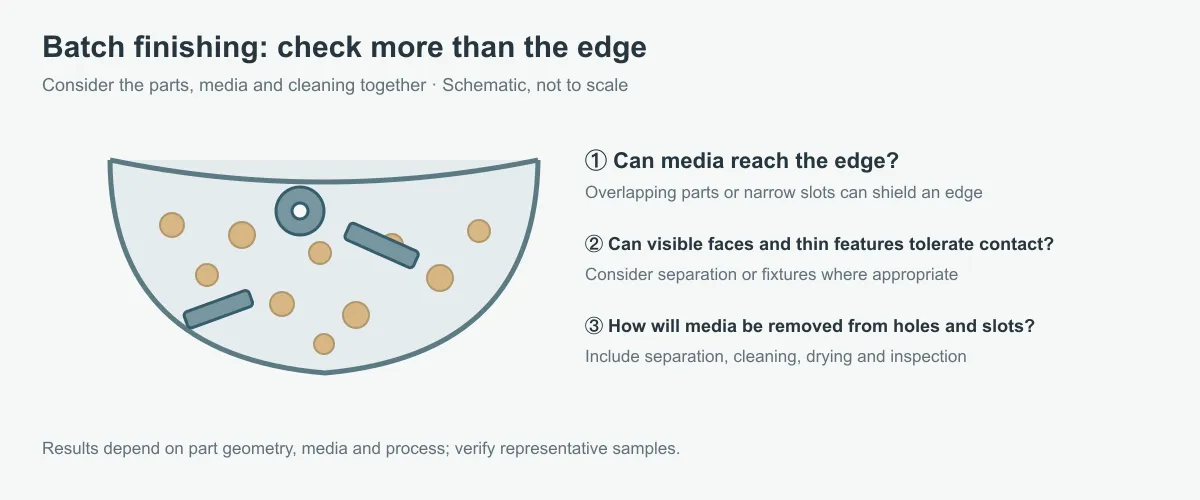
For stamped washers, flat clips or other small parts with similar edge requirements, vibratory finishing or tumbling may be appropriate. Compare more than the number of parts loaded per batch:
- Can parts overlap and shield edges from the medium?
- Can thin features, sharp corners and visible surfaces tolerate contact and collisions?
- Can media lodge in holes or slots, and can it be separated and cleaned reliably?
- Do the permitted edge removal, appearance and dimensions suit an overall treatment?
- How much time is needed for processing, separation, cleaning, drying and inspection together?
Some parts can be separated or held in fixtures rather than processed loose together. [3] Features that must retain a sharp edge or special hole condition may need protection or a local operation; agree the approach on samples.
Compare the full cost of an acceptable part
Compare proposals against the same drawing revision, quantity and acceptance requirements. Include preparation, fixturing, processing, turning, separation, cleaning, inspection and potential rework—not just machine speed or hand labor per part.
Small quantities may favor flexible local handwork; repeat orders may justify comparing the preparation cost of fixtures or batch processing. Appearance damage, trapped media or out-of-tolerance dimensions can change the total through sorting and rework. Agree the required result before comparing prices so that the quotations cover the same work.
What should the drawing and sample specify?
A buyer does not have to choose a machine before requesting a quote. Use a drawing, sketch or photo to explain how the part is used, then agree the edge requirements:
- Mark edges touched by people, openings used by cables and mating, sealing or locating areas.
- Identify surfaces and special holes to protect, and provide the exact installation requirements for the selected fastener.
- Where a defined chamfer, radius or residual burr limit is needed, state the location, dimension and inspection method. If undecided, explain the function first.
- State whether inspection is after deburring, after finishing or after assembly; agree an appearance sample where needed.
- For internal passages, describe cleanliness requirements and accessible inspection locations, and agree the inspection and sampling method.
The public scope of ISO 13715:2017 covers indication of edges of undefined shape. Explicitly defined geometry, such as a specified chamfer, follows the corresponding dimensioning principles. [7] Apply the complete standard and drawing requirements agreed by the parties when selecting symbols and contractual requirements.
For a metal-part project, send a drawing, sketch or photo with the material, expected quantity and edges of concern. If the material, finish or edge requirements are still undecided, start by explaining the intended use.
- [1] Rösler: Deburring — mechanical, mass-finishing and blasting overview.
- [2] Rösler: Edge rounding — distinction between deburring and rounding.
- [3] Rösler: Tub vibrators — page 4, vibratory finishing and fixtures or dividers.
- [4] Brush Research: Flex-Hone brochure — page 3, a specific tool for cross-hole deburring and cleaning.
- [5] Extrude Hone: Abrasive Flow Machining — process, removal factors and applications.
- [6] Extrude Hone: Thermal Deburring Technology — mechanism and oxide removal.
- [7] ISO 13715:2017 official page — public abstract and scope.