A dry cover, an outdoor bracket and a frequently washed enclosure have different material requirements. Locate water, deposits and handling damage, then compare how each finished part addresses them.
Zinc coating and stainless passive film protect in different ways
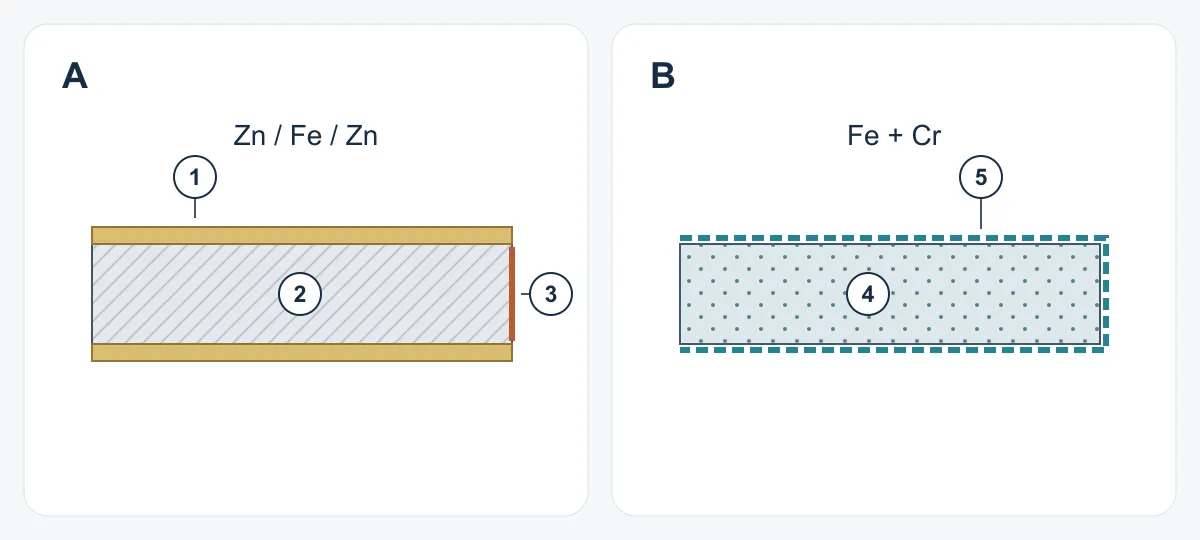
Galvanized sheet combines a steel core with zinc. The coating provides a barrier and can corrode preferentially to protect nearby exposed steel. Cut-edge protection is limited by coating condition, exposed-steel width and environment. [5]
Stainless steel contains chromium throughout the alloy. A thin passive film forms at the surface and can reform on clean metal in suitable oxidizing conditions. Cutting exposes more stainless alloy, but corrosion resistance still depends on grade, surface and exposure; chlorides, temperature and crevices can challenge that protection. [4]
At a connector opening, a cut through pre-coated steel exposes its substrate and needs an edge-protection review. A stainless cut remains alloy, while its burrs, contamination and surrounding joint still need review. Compare these finished features; the two sheets do not have the same protective skin.
Define which galvanized route the drawing requires
Continuously hot-dip-coated sheet receives its coating before the blank is cut and formed. Batch hot-dip galvanizing coats a fabricated article after its fabrication. These routes cannot be exchanged merely by writing 'galvanized' on the purchase order. The process order changes which edges and joints exist when the coating is applied. [1]
Electrogalvanized sheet receives zinc by an electrolytic process, commonly producing a thin, uniform coating. This route does not guarantee the same corrosion or forming performance as continuously hot-dip-coated sheet. Specify the coating and surface condition; a commercial abbreviation may leave those requirements unresolved. [3]
For a pre-coated cover, identify the finish for cutouts and joined areas. For post-fabrication coating, review holes, fits and assembly sequence. Identify the quoted route so the drawing, sample and production parts describe the same construction.
Use the exposure and maintenance conditions to narrow the choice
Describe actual wetting: rain, condensation, washdown, salt deposits or liquid retained inside a joint. Add the expected cleaning access and appearance requirement. 'Indoor' can include condensation; 'outdoor' can describe very different exposure. A material choice becomes useful when those conditions are tied to specific locations on the drawing.
| Part condition | Galvanized-steel review | Stainless-steel review |
|---|---|---|
| Mostly dry cover, occasional handling | Coating type, scratches, exposed edges and required paint system | Grade, specified finish and handling contamination |
| Recurring moisture or salt deposits | Coating condition and protection at exposed steel; do not assume unlimited cut-edge protection [5] | Grade suitability, temperature, deposits and restricted wet joints [4] |
| Painted cosmetic face | Pretreatment compatible with the zinc surface and the selected paint [2] | Agreed appearance and any additional surface treatment |
| Wet overlap or fastener connection | Trapped liquid, zinc condition and contact with other metals [6] | Crevice geometry, drainage and contact with other metals [4][6] |
If stainless remains a candidate, use the dedicated grade guide to compare 304 and 316 against the known exposure. If an existing part already has rust marks, investigate their location before deciding that changing the material is the only remedy.
Check the material after cutting, bending and welding
A flat coupon misses the features that fabrication adds. On coated sheet, forming behavior depends on the substrate grade, coating, thickness, tooling geometry and lubrication. Review tight bends and drawn features for the required finished coating condition rather than assigning one universal bend rule to all galvanized sheet. [2]
Fusion welding can affect the zinc protection around a joint, so the drawing and process review should address the required protection after welding. For stainless, weld performance depends on the alloy and welding procedure. Specify the finished joint and surface condition, including areas that will become inaccessible after assembly. [2][8]
Example: a painted enclosure has a welded corner and a removable lid. Compare the corner after its complete weld and finish sequence, and compare the lid edge after repeated assembly. The visible face alone cannot tell you whether the concealed corner, contact points and sealing surfaces meet the same requirement.
Wet assemblies need contact and drainage decisions
Dissimilar metals can form a galvanic couple when they are electrically connected and an electrolyte is present. The relative wetted areas matter: a small anodic area connected to a large cathodic area can face a more demanding condition. Review galvanized steel joined to stainless or other metals using the actual contact, wetting and area relationship. [6]
On a bracket bolted beneath a cover, water may enter around the fastener and remain between overlapping faces despite a dry exterior. Mark that location for drainage, sealing or joint review; changing the sheet category leaves the water trap unresolved.
Electrical isolation may help control dissimilar-metal contact, but the proposed isolation must still satisfy structural, electrical and functional requirements. A grounding point, for example, needs its required connection defined. Coordinate corrosion control with the joint's purpose; a washer or seal must be evaluated as part of the assembly. [6]
Strength and fit belong to the specified grade and geometry
Do not rank strength by 'galvanized' and 'stainless'. Obtain the specified substrate or alloy properties in its supplied condition. Check load, thickness and geometry, and match forming and joining choices to that material condition.
For a bracket, identify the load direction and the bend, hole or joint carrying it. For a cover, identify deflection that would disturb a seal or connector. Review these functions alongside any proposed substitution and manufacturing change. Matching thickness or a better corrosion description does not approve a substitute.
Compare the cost of an accepted complete part
Request comparable quotations for the same drawing revision, quantities, acceptance criteria and delivery pattern. Sheet purchase price is one input. Add the operations needed to reach the finished condition, then examine which assumptions could change when the design or order size changes.
Show alternatives explicitly so the buyer can assess apparent savings against extra finishing, inspection or maintenance. Where future maintenance is uncertain, state assumptions and compare scenarios rather than assigning unsupported service-life savings.
| Cost category | Questions for either material route |
|---|---|
| Material and yield | Which grade, thickness, coating or finish is priced, and how is the blank layout treated? |
| Cutting, forming and joining | Which operations, tooling or fixtures are included for this revision and order quantity? |
| Finished surfaces | Which edge protection, weld cleanup, paint or other specified treatment is included? |
| Inspection and acceptance | Are material records, representative samples and required tests included on the same basis? |
| Packing, delivery and maintenance | Are cosmetic protection, delivery pattern and any maintenance assumptions comparable? |
Accept the representative part and its critical locations
Agree on a sample containing the features that could change the outcome: a cut edge, the relevant bend, a production-representative weld and the actual joint or fastener combination. Record the proposed material and complete finish route alongside it.
Mark inspection locations and agree on appearance, dimensional, surface and functional acceptance as applicable. A concealed wet joint may need different evidence from an exposed cosmetic face. Record whether the sample represents the intended production route, and identify any differences that still require validation.
Accelerated salt-spray results can help screen or compare coatings within an agreed test setup. They do not convert directly into years of field service. Keep the method, sample condition, exposure duration and assessed defects attached to the result, and use application-specific evidence when service performance must be established. [7]
- [1] GalvInfoNote 2.3 — Continuous sheet galvanizing and batch hot-dip galvanizing
- [2] SSAB — Hot-dip galvanized coating
- [3] SSAB — Electrogalvanized coating
- [4] Outokumpu — Stainless steel corrosion resistance
- [5] GalvInfoNote 3.6 — Zinc coating cut-edge protection
- [6] American Galvanizers Association — Dissimilar metals in contact
- [7] GalvInfoNote 3.4 — Accelerated corrosion testing of zinc-coated steel sheet
- [8] Outokumpu — Welding stainless steel