1. Identify the type of document first
RoHS restricts certain hazardous substances in electrical and electronic equipment within its scope. A RoHS test report received when buying metal is part of the relevant technical evidence; it is not a general “environmental certification” awarded to a metal type. European Commission explanation of RoHS
For a document labelled REACH, continue reading the title and test request: does it screen SVHCs on the Candidate List, or test a particular restriction? The SVHC Candidate List, Authorisation List and Annex XVII restrictions serve different purposes. An SVHC report alone cannot establish that “all REACH requirements have passed”. Information duties concerning candidate substances must also be distinguished from the prohibitions in a particular restriction. HSA: SVHCs and authorisation, HSA: REACH restrictions
| Document | Main question it answers | What still needs checking |
|---|---|---|
| RoHS test report | Results and related decisions for specified samples and test items | Target market, applicable product requirements, and the link between the sample and actual supply |
| REACH SVHC screening report | Substance screening results within a specified list date and test scope | Coverage of the required list and applicable requirements; it does not cover all REACH matters |
| Mill test certificate / material certificate | Material identification, chemical composition and agreed mechanical tests, for example | Whether suitable evidence separately supports the required restricted-substance items |
| SDS / MSDS | Safety information on material hazards, storage, use and disposal | It does not establish that a particular batch has undergone restricted-substance or mechanical testing |
An SDS can convey supply-chain safety information but cannot replace all required product evidence. EU-OSHA explanation of SDS purposes If the question is how heat numbers, coil numbers or mechanical properties relate to delivered material, continue with the steel mill certificate guide.
2. Match sample descriptions, test parts and supplied material
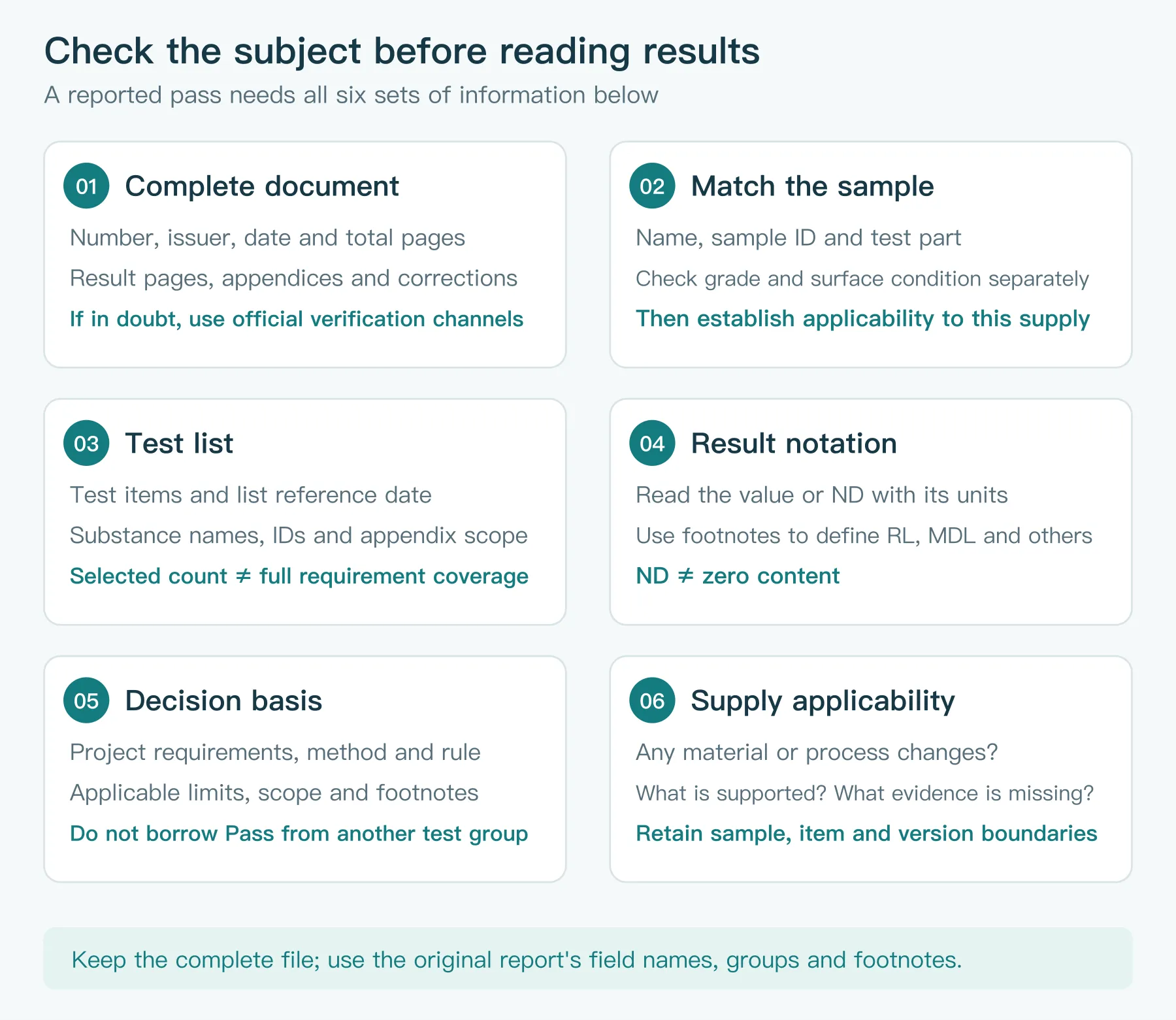
Keep the complete document first. Check the report number, issuing organisation, issue date, total pages, appendices and any correction or supplementary pages. If anything is unclear, verify it through the issuer's official channels. A stamp, logo or screenshot of the cover alone does not establish authenticity.
Then find the sample name, sample ID, test-part ID and descriptions. These may appear on different cover, result and photograph pages. “Silvery metal” describes appearance, not a verified grade. Even an identical grade designation does not necessarily establish the same coating, passivation, oil film or other surface condition. If the client supplied the sample and its name, distinguish information supplied by the client and recorded in the report from items actually tested by the laboratory.
RoHS mass-fraction comparisons must also use the homogeneous-material assessment basis. If an item refers to a substrate, coating, complete sample or combined test group, first confirm sample separation and the mass basis of the result. Do not treat a combined-sample value as the value for every homogeneous material it contains. Ireland EPA: the material assessment level under RoHS
Ask the supplier to explain why the report applies to this supply, including the material source, specification, surface treatment and relevant change records. The aim is a credible correspondence, not an automatic demand to retest every coil. Sampling and document-update arrangements should follow project requirements and applicable rules. If plating, paint, adhesives or fittings are added later, reassess the material report's coverage; it cannot simply be extended to the whole finished part.
3. Read the test list to establish scope; do not infer it from “Pass”
One report may contain items declared to pass, additional items with results only, and items that were not tested. Read each conclusion on the cover separately. “Pass” for one group does not automatically extend to other items labelled “See Results”.
For SVHC reports, connect the cover's test request, list reference date and appendix of substances. For example, if the cover specifies selected tests for 62 inorganic and 11 organometallic substances, totalling 73 candidate substances, plus 1 potential substance, the conclusion covers those selected items. Do not describe this as the complete current Candidate List or add the potential substance to the Candidate List total. The supplier-provided nickel-silver SVHC report illustrates these fields.
Checking names, CAS numbers and necessary substance-group descriptions item by item is more reliable than comparing only the number of tests. Some entries cover groups or several identifiers, so identical counts need not mean identical contents. If the result table shows only detected substances, check the appendix and footnotes for items not listed individually. Do not fill in “not tested” or “all zero” yourself.
4. Read ND together with its threshold, units and method
Use the report's own definition of ND first. Some reports define it as below the method detection limit, MDL; others define it as below the reporting limit, RL. The limit of quantification, LOQ, is another method characteristic. Do not interchange these thresholds without checking, and do not mistake RL or MDL for a legally permitted maximum content.
For example, the nickel-silver SVHC report above defines ND as below RL and explicitly states that RL is not a regulatory limit. Its RoHS report defines ND as below MDL in the footnotes. The same letters must be interpreted with each report's own notes.
| What the report shows | How to interpret it | What it does not directly establish |
|---|---|---|
| ND, defined in a footnote as below RL or MDL | Under that method and reporting rule, no result reaching the corresponding threshold is reported | Actual content is zero, or every unlisted substance is absent |
| An RL, MDL or LOQ value | A characteristic of the item's method capability, detection or reporting | It is the order limit, or a larger threshold means a stricter requirement |
| mg/kg or mass percent | With the same mass-fraction basis, 1 mg/kg = 0.0001% | A direct numerical comparison with an area-based result in μg/cm² |
| “—”, “/”, “not applicable” or a blank | Check the report's symbol definitions and ask the laboratory if necessary | An automatic assumption that it was tested, not detected or accepted |
| Pass, compliant, negative or inconclusive | Read it with the relevant sample, item, method and decision rule | That different terms mean the same conclusion in every method |
A result table may also mix units. For example, hexavalent chromium in a metal corrosion-protection coating may be reported in μg/cm² and assessed for its presence under the relevant method. The public abstract of IEC 62321-7-1 distinguishes negative, inconclusive and positive outcomes. Do not directly compare that area-based result with a conventional mg/kg content. Scope of IEC 62321-7-1
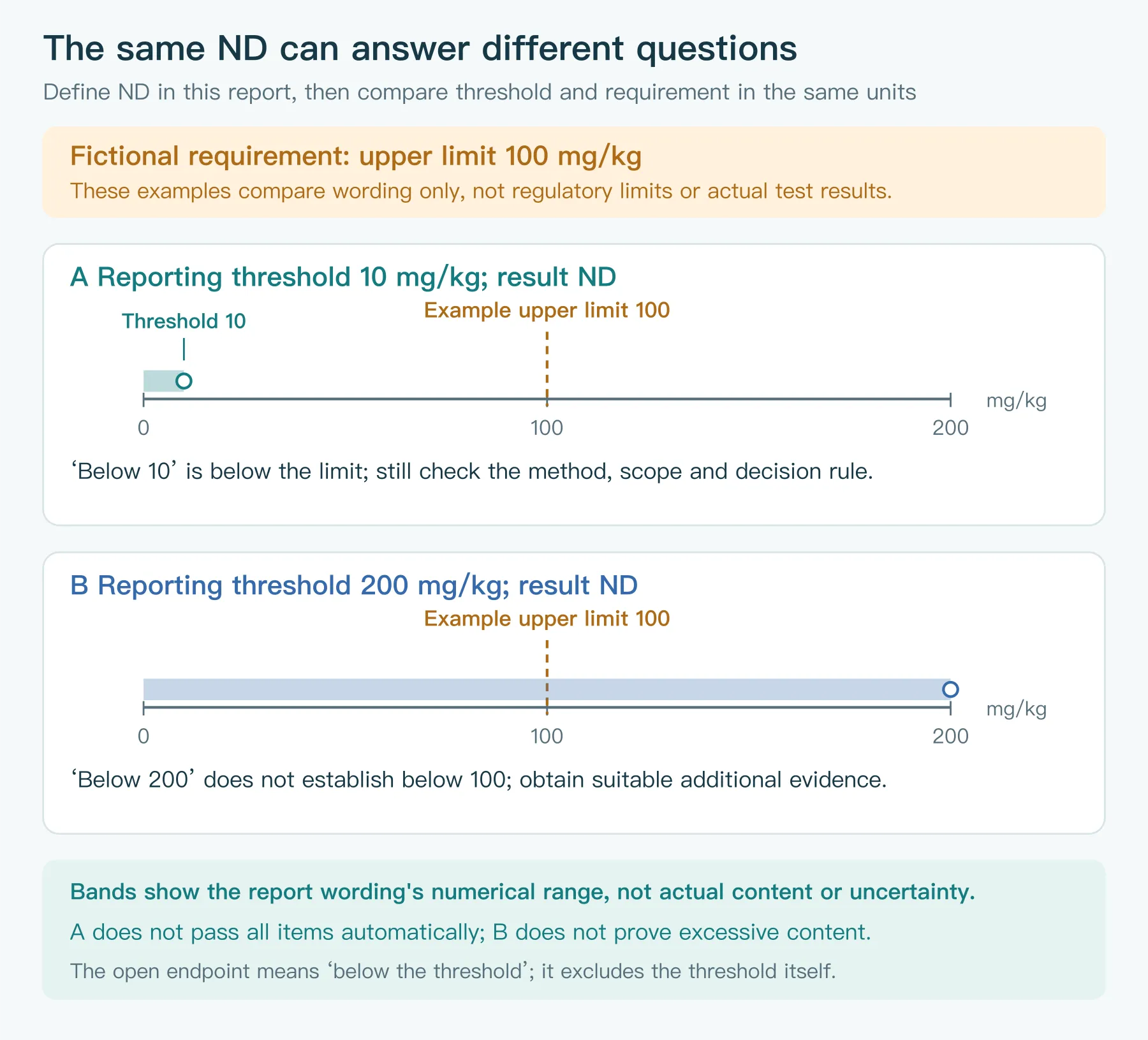
Assume a fictional purchasing upper limit of 100 mg/kg for an item, and that both examples define ND as below the listed reporting threshold. Example A has a threshold of 10 mg/kg: numerically, “below 10” falls on the “below 100” side. Example B has a threshold of 200 mg/kg: “below 200” alone still does not answer whether the value is below 100.
These are not actual material results or acceptance rules for all methods. For A, method applicability, sample coverage and the decision rule still require checking. B indicates the need for more suitable evidence or a method; it does not directly establish excessive content. ND for any single item cannot automatically pass an entire order or every regulatory requirement. If a result approaches a decision boundary or is called inconclusive, follow the agreed rule rather than selecting repeated results until one is satisfactory. ILAC explanation of decision rules and conformity statements
5. Read report dates alongside list dates and material changes
Record at least the sample-receipt date, testing date, report issue date, and the version date of the referenced list or specification separately. A recent issue date does not guarantee the test list meets the current project's required version. An older report still records the test facts at that time, but its suitability for today's order requires a separate assessment.
Do not make a universal judgement based only on whether a report is more or less than a year old. Check the customer's agreed document-age requirement first, then changes in material source, composition, surface treatment, production site or relevant processes, and updates to applicable lists and requirements. When items are added to a list, identify the gap between those additions and existing evidence. The supplier, laboratory and responsible project parties should determine suitable supplementary evidence. Do not simply put a new date on an old PDF, or claim without checking that all previously tested items must be retested.
Some results are also limited by the sample condition and time of testing. If a footnote states that production dates or storage conditions were unavailable and the result describes only the state at testing, preserve those conditions when passing on the report. Do not remove them from a summary table.
6. Use a checklist to state what is accepted and what is missing
The following is a fictional document-review record, not a pass or fail decision for an actual supplier, material or order. It shows how to record missing information separately from a demonstrated failure to meet a requirement.
| Review item | Finding in the teaching record | Next step and scope of conclusion |
|---|---|---|
| Sample correspondence | Only “metal strip” is named; the order has an additional surface-treatment requirement | Obtain the sample condition and its link to supply; applicability is not yet established |
| Test list | A dated selected-test list is available, but the customer requires broader coverage | Compare gaps by substance identity; preserve tested results without inventing untested results |
| Reporting threshold | The ND reporting threshold exceeds the fictional purchasing upper limit | Confirm an applicable method and supplementary evidence; do not directly record excessive content |
| Document version | The issue date meets the customer's age requirement, but the supplier reports a changed surface condition | Review the effect of the change before deciding where the report remains applicable |
| Additional items | A cover-page group says “See Results” without a conformity statement | Check results against project requirements and the decision basis; do not borrow another group's Pass |
The final record can distinguish supported items, items awaiting information, and identified nonconformities. Include the report version, sample or material range, reviewer and approval basis. Do not turn a supplier's material report into a factory certificate, or present unresolved evidence gaps as completed testing.
When purchasing galvanized sheet, nickel silver or stamped parts, provide the customer requirements, complete reports, proposed material and surface-treatment information together. If the required document type is unclear, start with the part's use, sales region and the specific customer clauses, then discuss the document scope and outstanding questions.