1. Carbon equivalent is not the steel’s actual carbon content
On a certificate, C means carbon content. CEV or Pcm is a calculated value combining C with other specified elements. Record them separately. For example, C = 0.10% and CEV = 0.381% are compatible: the latter includes contributions from other elements in the formula. It does not mean that the steel actually contains 0.381% carbon.
Carbon-equivalent formulas originally summarized composition-related hardenability and were subsequently used to discuss composition and susceptibility to hydrogen-induced cold cracking. The common IIW equivalent and Pcm have different research backgrounds; Pcm was developed principally for lower-carbon low-alloy steels.[1] Descriptions such as “low alloy”, “high strength” or “weldable” therefore do not, on their own, establish the calculation method required for an order.
Start with the definition in the order, material standard, project requirements or proposed welding assessment method. If a document says only “CE”, identify the exact equation. If it specifies CET, do not enter a CEV result in that field. A calculator producing several outputs does not make all of them valid for the same acceptance condition.
2. Keep each formula’s name and purpose with its result
This comparison uses CEV (IIW) and Pcm (Ito–Bessyo). The Japan Welding Engineering Society lists CE(IIW) and Pcm separately and explicitly specifies mass-percent inputs.[2] Written in grouped form:
CEV (IIW) = C + Mn/6 + (Cr + Mo + V)/5 + (Ni + Cu)/15
Pcm = C + Si/30 + (Mn + Cu + Cr)/20 + Ni/60 + Mo/15 + V/10 + 5B
Enter the numerical mass percentage for C, Si, Mn and the other elements. For Mn = 1.35%, enter 1.35, not 0.0135. If a table already identifies its unit as %, a cell reading 1.35 is already on that basis. B in the Pcm formula means boron; it is unrelated to a quality-designation letter B at the end of a steel name.
| Item to check | CEV (IIW) | Pcm (Ito–Bessyo) |
|---|---|---|
| Elements required by these formulas | C, Mn, Cr, Mo, V, Ni, Cu | C, Si, Mn, Cu, Cr, Ni, Mo, V, B |
| How elements contribute | Mn has a coefficient of 1/6; other elements are grouped as specified | Mn has a coefficient of 1/20; Si/30, 5B and other specified terms are included |
| What determines selection | Whether the applicable material/project requirement specifies IIW and the subsequent method uses that value | Whether the applicable requirements and material range support Pcm, with all required inputs available |
| Appropriate comparison | The requirement for the same formula and applicable material, thickness and other conditions | The requirement defined for Pcm, not a CEV limit |
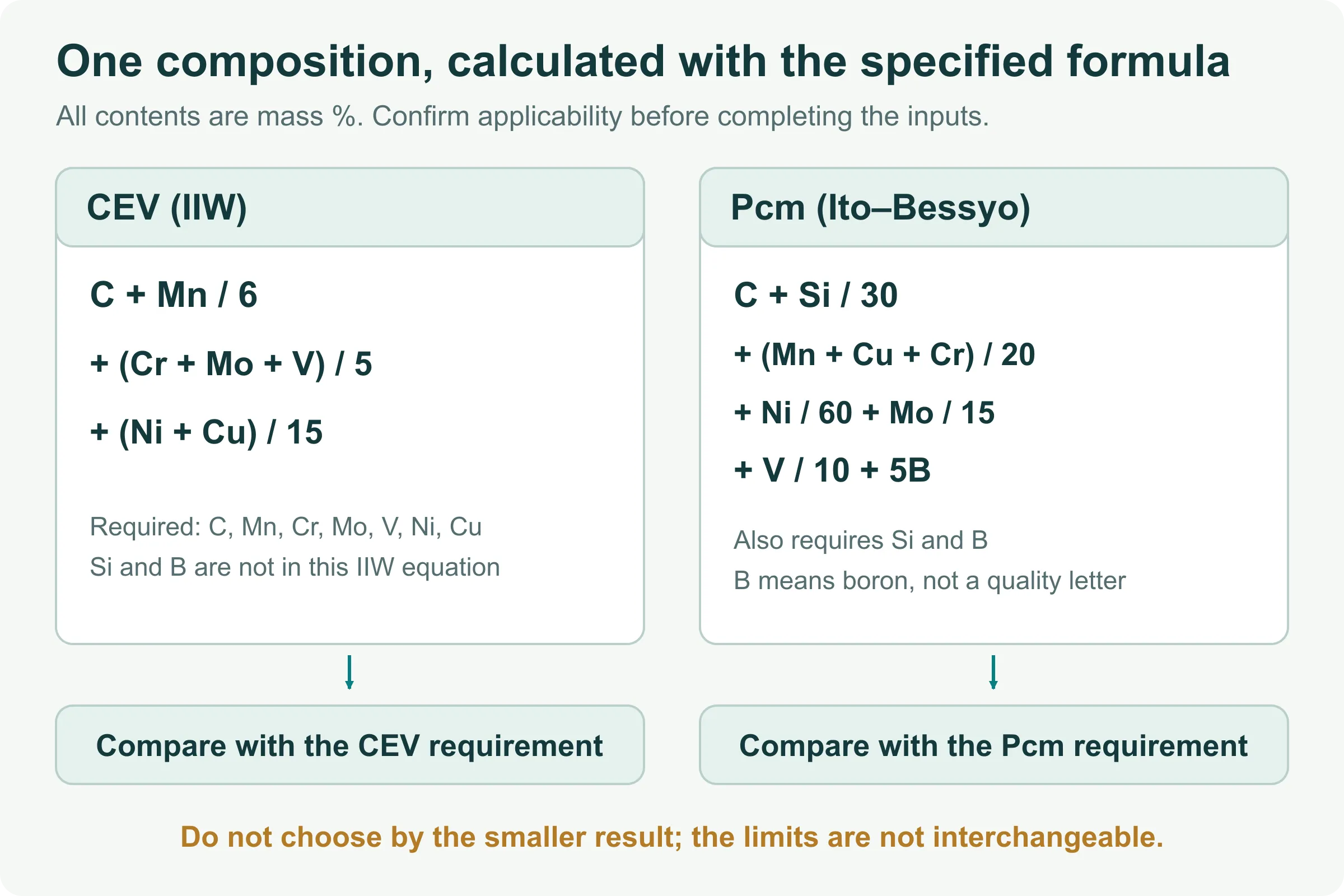
Different weights for the same element naturally produce different results. A lower Pcm does not mean “twice the weldability”, and calculating both does not justify choosing whichever passes a limit more easily. Dillinger likewise lists carbon equivalents separately and defines an application range for its subsequent welding-parameter method.[3]
3. Read the certificate data completely before entering it
Data used to assess a batch must be traceable to the delivered material. Match the heat, coil or plate identity to the certificate before reading its composition table. Another heat’s certificate, catalogue typical chemistry or a standard’s permitted maximum cannot be relabelled as the actual analysis of the plate in front of you. SSAB also links certificate composition with plate identity and specifies mass-percent inputs.[4]
Identify whether the record is heat analysis or product analysis, and which basis the applicable requirement uses. They represent different sampling stages and objects. Do not combine C from heat analysis, Mn from another plate’s product analysis and a typical catalogue B value. If specified maxima are used for a conservative purchasing-stage estimate, label it “estimate from combined upper limits” and confirm that the method permits this treatment. It is not an actual heat analysis and does not replace incoming verification.
A blank, a dash or an unlisted element does not establish zero content. If the formula needs an element absent from the certificate, ask the supplier about the actual analysis, reporting scope or treatment permitted by the applicable requirements. A calculator that defaults blank fields to zero has applied a software assumption; it has not supplied missing material evidence.
Retain qualifiers such as “<0.0010%” and establish whether they refer to a reporting limit, detection limit or another condition. Use the applicable handling rule. If that upper bound is temporarily used to explore its effect, label the calculation “upper-bound estimate”. Do not record it as a measured 0.0010%, or silently change it to zero. Near an acceptance limit, also check original data precision, rounding and the conformity decision rule.
4. A reproducible example: two results from the same composition
Illustrative calculation: the assumed composition below demonstrates units, weighting and verification. All values are supplied and treated as one analysis record. They do not represent a specified grade or actual heat. Calculating both equations does not establish approval to use both methods for a real material.
| Element | Assumed content (mass %) | Check |
|---|---|---|
| C, carbon | 0.10 | Included directly in both formulas |
| Si, silicon | 0.24 | Absent from this CEV equation; enters Pcm as Si/30 |
| Mn, manganese | 1.35 | Different weighting in the two formulas |
| Cu, copper | 0.15 | Grouped according to each formula |
| Ni, nickel | 0.18 | Divided by 15 in CEV and by 60 in Pcm |
| Cr, chromium | 0.12 | Grouped according to each formula |
| Mo, molybdenum | 0.03 | Divided by 5 in CEV and by 15 in Pcm |
| V, vanadium | 0.02 | Divided by 5 in CEV and by 10 in Pcm |
| B, boron | 0.0010 | Equivalent to 10 ppm by mass; multiplied by 5 in Pcm |
Substitute into CEV:
CEV = 0.10 + 1.35/6 + (0.12 + 0.03 + 0.02)/5 + (0.18 + 0.15)/15
= 0.10 + 0.225 + 0.034 + 0.022 = 0.381%.
Substitute into Pcm:
Pcm = 0.10 + 0.24/30 + (1.35 + 0.15 + 0.12)/20 + 0.18/60 + 0.03/15 + 0.02/10 + 5×0.0010
= 0.10 + 0.008 + 0.081 + 0.003 + 0.002 + 0.002 + 0.005 = 0.201%.
Here, boron is 10 ppm = 0.0010%, contributing 0.005 percentage points to Pcm. Omitting B produces 0.196%, a plausible-looking number that is inconsistent with the supplied data. If B is missing from a real certificate, 0.196% cannot be described as a verified, complete Pcm result either.
Keep the original inputs, units, formula name and unrounded intermediate results, then report the required number of digits. The example’s 0.381% and 0.201% establish only the arithmetic for the stated inputs. They do not establish material acceptance or release for welding.
5. Separate calculation accuracy from meeting a requirement
A useful calculation sheet lets a reviewer trace the requirement, material, input, equation and conclusion. A number without its formula and data source makes it difficult to decide whether the record remains applicable after a change of heat, thickness or welding process.
| Record field | Information to retain | Response to a discrepancy |
|---|---|---|
| Requirement and formula | Document identifier, edition, clause and complete CEV/Pcm definition | Clarify an entry labelled only CE; the same abbreviation can hide different equations |
| Material identity | Complete designation, delivery condition, thickness, heat and coil/plate identity | Restore traceability if the record cannot be matched to the material |
| Analysis basis | Certificate identifier, heat/product analysis and sampled material | Do not mix records or silently change the analysis basis |
| Elements and units | Original values, mass %/ppm, blanks and qualifiers such as “<” | Obtain required inputs and document conversions and permitted treatments |
| Calculation and comparison | Formula version, inputs, intermediate values, rounding rule and corresponding limit | Record arithmetic verification separately from conformity assessment |
| Conclusion and scope | Compliance with this material requirement, unresolved issues, approver and applicable order | Do not expand one satisfactory result into approval of all welding conditions |
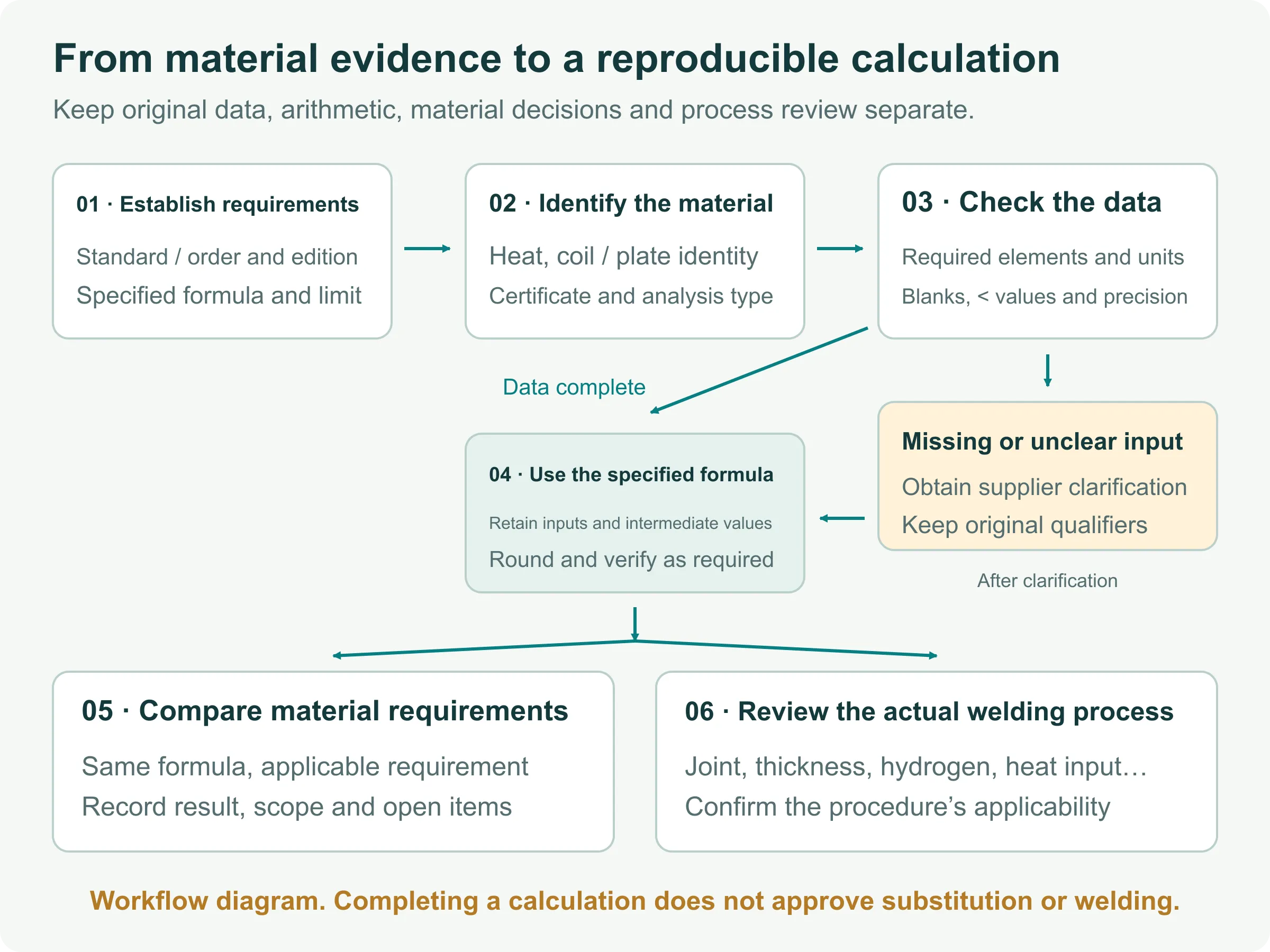
For example, if an order explicitly limits CEV but the supplier supplies only Pcm, obtain the required formula inputs or suitable additional evidence. “Pcm is lower” is not a valid reason to accept it. Conversely, where Pcm is required and B remains unknown, keep that item open; a complete CEV record does not resolve it.
6. Apply the result to the actual joint and welding process
Carbon equivalent describes the composition factor. Hydrogen cracking also involves hydrogen, susceptible microstructure and tensile stress. Thickness combinations, joint restraint, process, consumables and heat input affect the assessment as well.[5] One CEV or Pcm number therefore cannot specify a preheat temperature for every component. A purchasing table saying “no preheat below this value” would omit essential conditions.
Material acceptance and production release can have separate, precise statuses: for example, “certificate matched to material and calculation verified; welding-procedure applicability awaiting confirmation”. For a joint between different materials, retain the identity and composition evidence for each, then assess the complete joint under the applicable method. Do not average the two compositions into an imaginary material.
A lower carbon equivalent does not automatically satisfy the drawing’s grade, quality designation, delivery condition, impact requirements or other inspections. Material substitutions need assessment against the complete requirements. For Q355N, Q355M and subsequent heating, see the guide to steel delivery condition and processing review.
7. Information to provide with a quotation request
For welded brackets, frames or other sheet-metal parts, begin with the drawing, specified material, thickness and expected quantity, and identify welds and important mating features. If a certificate is available, include its composition page and relevant material identification. Customer or order details can be redacted where necessary, while retaining the information needed to establish the material relationship.
If the drawing says only “low carbon equivalent” or the certificate reports one undefined CE value, highlight that question. Establishing the complete requirement, formula and available material evidence before discussing processing gives the quotation a more useful basis than selecting whichever result appears lower.
- [1] TWI: Carbon equivalent formulas and hydrogen cracking, development backgrounds and applicability to low-carbon steels.
- [2] Japan Welding Engineering Society: Carbon equivalents and transformation temperature, CE(IIW), Pcm and mass-percent units.
- [3] Dillinger: WELDING calculation help, formulas, certificate inputs and calculation ranges.
- [4] SSAB: Carbon equivalent, certificate composition, units and material identification.
- [5] TWI: Hydrogen cracks in steels—prevention and best practice, cracking factors and process conditions.