1. Identify the material before naming the stain
Confirm whether the product is continuously galvanized sheet, sheet with another zinc-alloy coating, or a component galvanized after fabrication. Product requirements and treatment conditions can differ. This guide concerns suspected storage staining on sheet before processing; repair and acceptance rules for large batch-galvanized fabrications should not be transferred automatically.
Moisture retained between closely packed galvanized surfaces can produce zinc corrosion deposits commonly called white rust. [1] Investigate these separately from red rust involving steel, but do not use white, gray, black or reddish-brown as a stand-alone acceptance chart. Deposits, dirt, treatment residues and friction marks may require further distinction. Record observations such as “white-gray deposit” or “local darkening” before deciding on an identification.
Note whether the mark is on the original face, a cut edge, near strapping or at a sheet-to-sheet contact. One edge mark does not represent an entire sheet, and a clean outside does not prove that the pack interior stayed dry.
2. A dry outside does not establish a dry interior
Check both external water entry and condensation. When cold metal enters warmer humid surroundings, moisture may condense if its surface is below the local air’s dew point. Air temperature alone, or a statement that the delivery was never rained on, does not exclude this path. [2]
Close-contact surfaces restrict drying between sheets. Record the condition of the wrapping, exposed faces and interfaces that have actually been inspected separately. An inaccessible internal area remains unverified; it should not be marked “dry” by assumption.
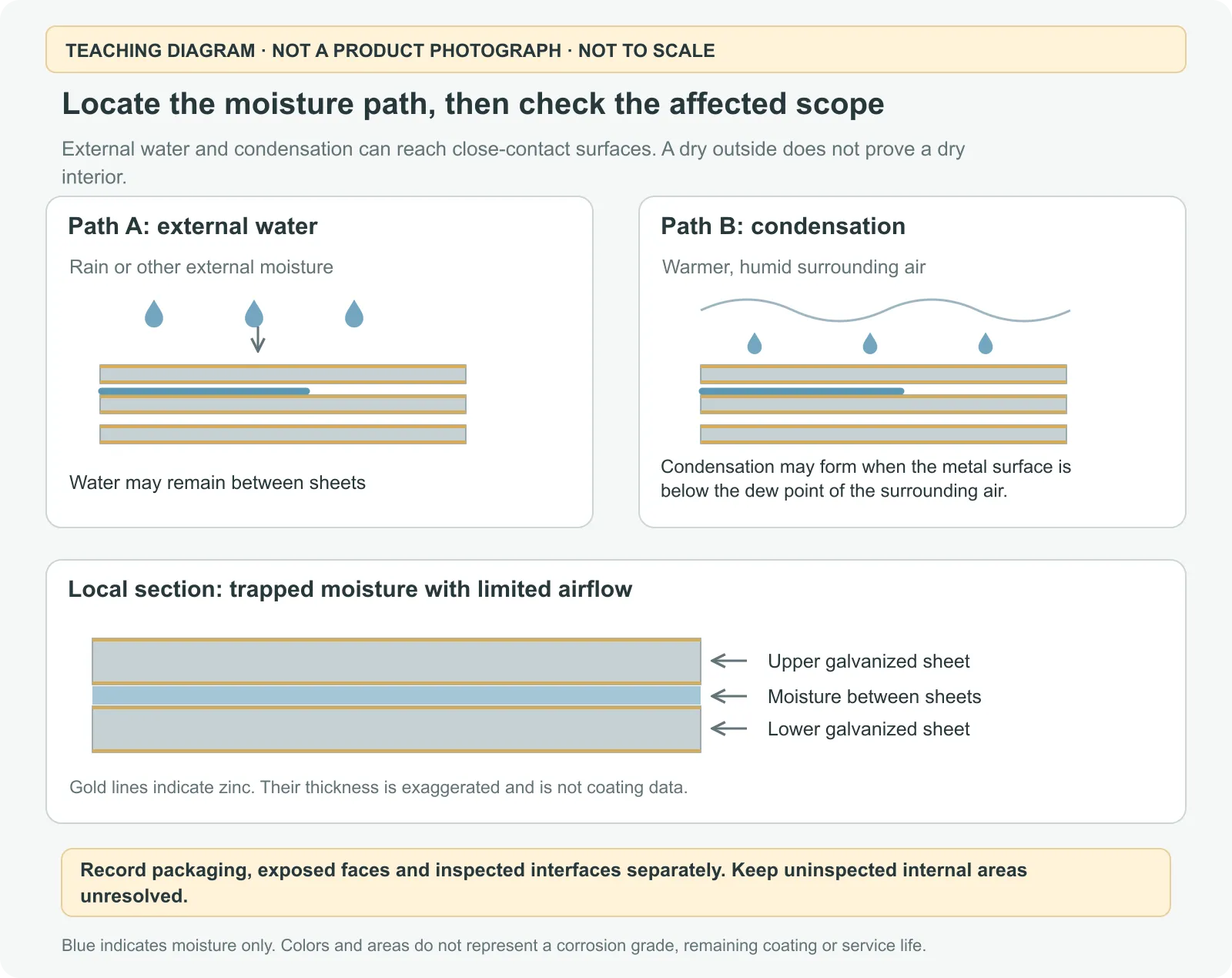
3. Preserve evidence while arranging safe inspection and drying
Keep material identification, packaging condition and anomaly locations together. A steel producer’s delivery guidance also identifies arrival documentation, photographs and prompt contact as useful inputs when an abnormal condition is found. [3] The following record fields help organize the investigation; inspection coverage and sampling must still match this delivery’s requirements.
| What to record | Details to retain | What the record helps establish |
|---|---|---|
| Material identity | Order, supply label, coil/sheet or lot ID, dimensions and coating description | Whether photographs and later checks concern the same material |
| Original appearance | Overall and close-up photos, scale, face and position in the pack | Distribution, location and before-and-after changes |
| Packaging and moisture | Damage or wet marks, standing water, strapping and contact locations | Possible water paths and areas needing further inspection |
| Timing and environment | Receiving, unpacking and discovery times; available humidity, air and metal temperatures | Possible timing of wetting and information still missing |
| Affected scope | Inspected sheets, uninspected interior and material already cut or issued | How to identify material awaiting review and prevent uncontrolled issue |
| Actions already taken | Location, method and time of wiping, drying, cleaning or sampling | How changes to the original condition affect later evidence |
Evidence collection and prevention of further wetting can be coordinated. Obvious water need not remain untouched until every photograph has been taken. Personnel with appropriate equipment and work arrangements should follow the site’s handling, unpacking and support procedures. Do not release bands or move heavy stacked material merely to obtain an internal photograph.
Dry cold stock and already-wet stock need different considerations. Evaluate condensation conditions before deciding when to open a dry cold package. If the wrapping or interfaces are already wet, promptly coordinate action with the supplier and site lead. Waiting for acclimatization must not become an instruction to keep wet stock sealed; drying must not become permission to unpack a heavy coil without a safe procedure. [1][3]
4. Review appearance, coating evidence and intended processing separately
Read the order’s coating designation, surface quality, supplied surface treatment and visible-face requirements. Galvanized products are available with different surface conditions and temporary treatments; the ordered product requirements determine what is acceptable. [2] The name “galvanized sheet” alone is not enough to apply one appearance criterion to every delivery.
If the coating is in question, agree the method, sampling positions, specimen condition and represented scope with the supplier or testing party. Area-average coating mass and a thickness measurement at one point are different results. Sheet-coating reports may concern both surfaces together or each side separately, according to the specified requirements. [4] The original mill certificate does not by itself establish that every affected area still meets all requirements after wet storage.
Then consider the part’s use. An exposed face, a surface to be painted, a contact area and a hidden face may require different reviews. State those requirements explicitly. “It will be painted later” is not an automatic basis for disregarding an anomaly. Acceptable appearance does not replace necessary coating verification, and a conforming coating result does not automatically satisfy a visible-face color requirement.
5. Agree treatment before changing the whole batch
Cleaning may alter visible deposits without restoring the original surface. Storage stain can leave an etched or dulled appearance even after deposits are removed. [1] Preserve the initial records, then have the responsible parties define any small-sample treatment, cleaning requirement and follow-up checks before treating the entire batch.
For parts that will be powder coated or painted, the material supplier and coating party should review the supplied surface treatment, proposed pretreatment and finishing system together. Compatibility requires a product-specific review. [3] A trial panel with an even color does not alone establish that the full batch satisfies adhesion, appearance and corrosion requirements.
Do not treat an online cleaning recipe, aggressive grinding or a touch-up method as a universal answer. Such actions may change the surface and the agreed processing conditions. Their use, represented scope and acceptance basis require the relevant approval. Retain cleaning, additional-testing and release records separately.
6. Use observations to select the next check
| Current observation | Priority checks | Next action and decision authority |
|---|---|---|
| Wet wrapping or interfaces, with no obvious deposit | Inspected and uninspected scope; water-entry or condensation conditions | The site lead arranges safe inspection and drying; quality personnel determine follow-up scope |
| White-gray powder or patches | Nature of deposits, material/coating requirements, distribution and wetting history | Preserve the evidence and agree necessary checks with the supplier; a photograph alone cannot authorize release |
| Local gray-black, dark or friction-like marks | Supplied surface condition, contact locations and other findings | Distinguish possible surface changes; color alone does not establish coating exhaustion |
| Reddish-brown marks, pits or suspected exposed steel | Location, depth or damage condition and material requirements | Extend the relevant investigation and base the proposed disposition on actual deviations; do not clean away the original evidence |
| Appearance improves after cleaning | Whether the method was authorized and the required post-treatment surface/coating evidence | Quality and contractually authorized parties decide acceptance, rework, concession or return from the evidence |
Darkening can be associated with differing surface conditions or friction. It should not automatically be described as steel-base corrosion or converted into a remaining-life estimate. [1][3] These observations organize the investigation; they are not corrosion grades.
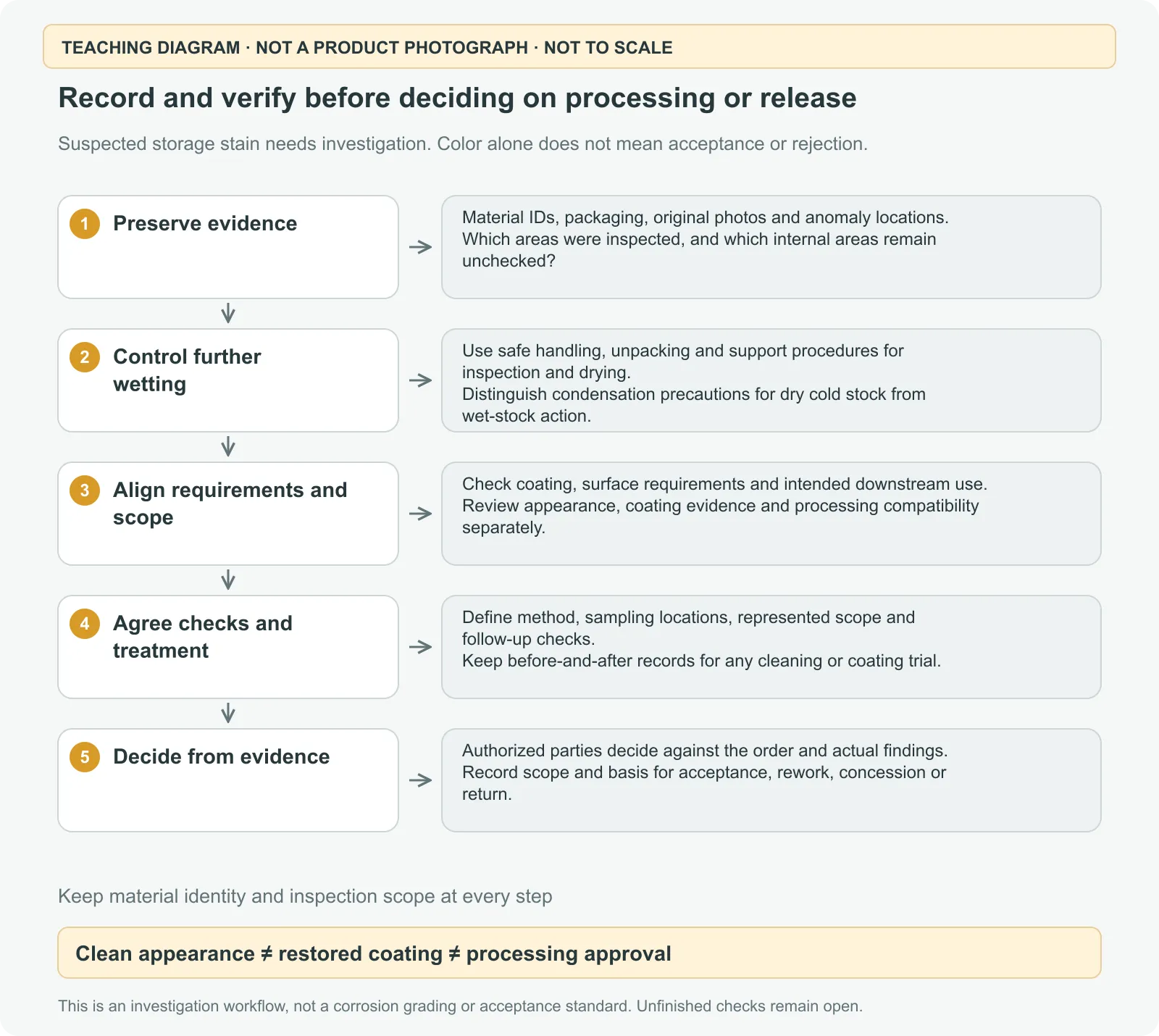
7. A receiving example with an unresolved interior
Suppose a pack is intended for painted panels. The wrapping has wet marks, and two opened sheets show white-gray patches at contact areas. The remaining interior has not been inspected. This is a hypothetical case without actual test data. The observations establish local anomalies, not that the whole pack is scrap or that wiping makes it ready for coating.
Link the affected locations to material IDs, preserve wrapping and photographs, and identify the unchecked scope. The site controls further wetting under its procedures while quality personnel and the supplier agree follow-up checks. If cleaning and coating trials are proposed, record where the samples came from, how they were treated and which requirements they will verify. State what scope the trial represents. The final disposition must still address the order’s material, coating, appearance and finished-part requirements.
8. Put the next delivery’s expectations in writing
Specify coating and surface requirements, later painting or coating needs, packaging and the communication process for receiving anomalies. Oiling and chemical treatments provide conditional temporary protection; they do not replace appropriate transport and storage. [2]
Consider rain protection, trapped water, condensation conditions and stock rotation together. Packaging selection and unpacking timing should follow supplier guidance and actual conditions. A universal storage-day limit is not an adequate substitute. Promptly sharing records is more useful for deciding the next action than assigning responsibility from a photograph.
For a fabrication discussion, provide material requirements, labels, original photographs and intended use. Identify the affected face, whether it was wet when found, and any treatment already performed. Existing companion guides explain galvanized-sheet selection and linking a mill test certificate to delivered material.
- [1] International Zinc Association, GalvInfo Note 3.2: Protecting Galvanized Steel Sheet Products from Storage Stain, Rev. 3.0, 2020.
- [2] SSAB, Metal coated structural steels: Surface Quality and Surface Treatments.
- [3] voestalpine, Hot-dip Galvanized Steel Strip: Technical Terms of Delivery, December 2025, pp.22–24.
- [4] ASTM A90/A90M-21, public Scope and Significance and Use.