Eight materials at a glance
| Material | Starting point | Check before specifying |
|---|---|---|
| SPCC cold-rolled steel | Formed enclosures and panels with a protective finish | Corrosion protection, preparation, exposed edges and contact areas |
| SECC electrogalvanized steel | Enclosures and covers requiring a zinc-coated surface | Coating specification, cut edges, bends and paint compatibility |
| SGCC hot-dip galvanized sheet | Pre-coated panels and brackets | Coating designation, damaged areas, cut edges and exposure |
| SPHC hot-rolled steel | Plate parts where appearance is less critical | Surface condition, forming and rust protection |
| SUS304 stainless steel | Formed covers and parts needing corrosion resistance | Chlorides, crevices, contamination, condition and finish |
| 5052 aluminum | Weight-sensitive covers and brackets | Temper, bend direction and radius, contact corrosion and finish |
| Q235 carbon structural steel | Load-bearing brackets and frames | Grade, loads, joints and corrosion protection |
| H62 brass | Formed hardware, appearance or contact functions | Condition, operating environment and contact requirements |
These are starting points, not interchangeable specifications. Grade and product standard, condition, sheet thickness, shape and exposure affect the result.
SPCC, SECC and SGCC: compare the finished part
SPCC cold-rolled sheet is a candidate for formed enclosures where a paint or powder-coat system supplies the required appearance and corrosion protection. Include surface preparation, masking and finish inspection in the comparison. Mark electrical contact faces and close-fitting holes before choosing where coating is allowed.
SECC electrogalvanized sheet has zinc applied before parts are made. It can provide a measure of corrosion protection to the sheet surface. Specify the applicable coating and surface condition and check whether the intended paint process is compatible. A grade name alone does not establish an outdoor service life.
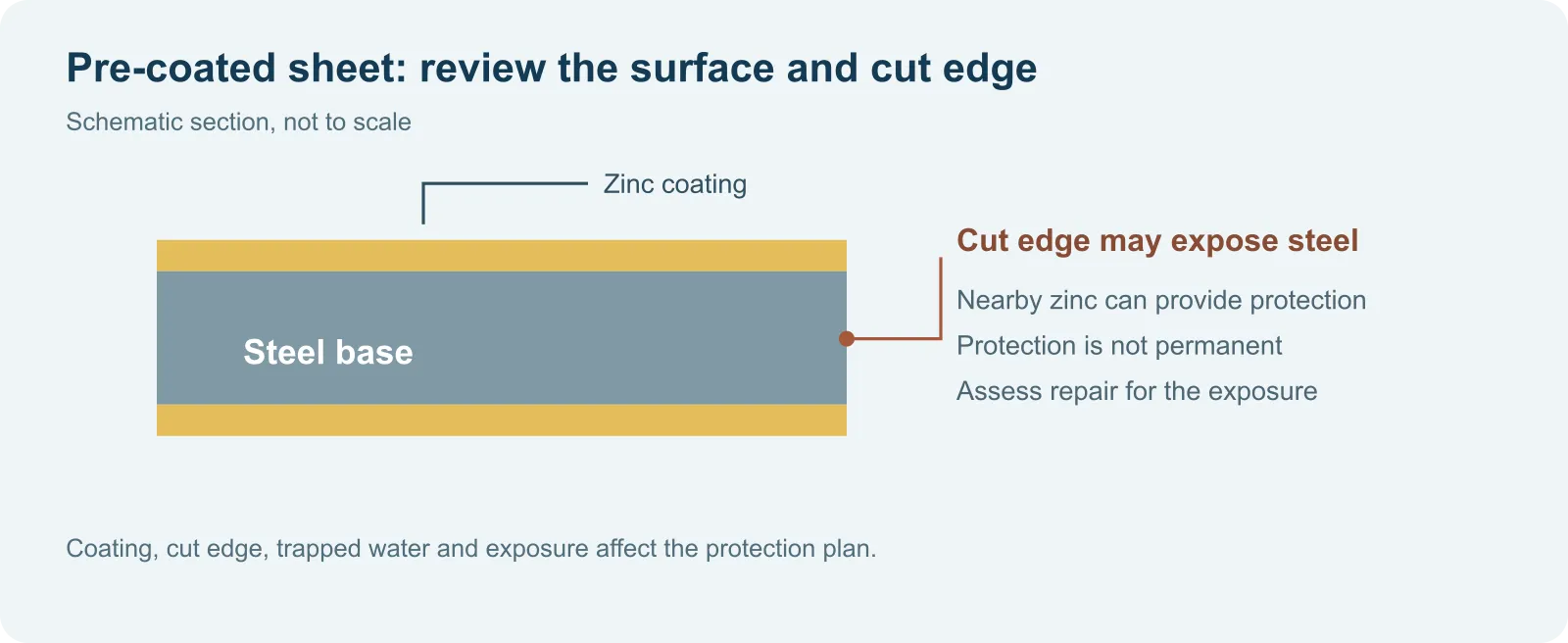
SGCC is continuously hot-dip galvanized sheet. Specify the applicable coating designation; do not assume all sheets have the same coating thickness. Continuous sheet coating is different from immersing a completed fabricated part in molten zinc. Cutting and punching may expose the steel at edges; nearby zinc can offer some sacrificial protection, but that does not remove the need to evaluate the edge, seams and wet exposure. Repair or additional protection may be appropriate for the application. [1]
SPHC and Q235: define the structural job
SPHC is a hot-rolled sheet grade that can be considered for parts where surface appearance is less critical. Surface condition and any scale removal affect finish preparation. Verify forming against the actual supplied thickness, condition and geometry.
Q235 is a carbon structural steel designation. SPHC and Q235 describe different product and standard categories and should not be treated as automatically equivalent. For a load-bearing bracket, define the applicable grade, thickness, loads, joint and corrosion protection. Impact, fatigue or safety-critical service requires appropriate design and validation.
304 stainless steel or 5052 aluminum?
304 stainless steel is a candidate for formed parts requiring corrosion resistance. It can still suffer localized corrosion in chloride-containing conditions, especially at crevices or deposits. Describe cleaning chemicals, trapped moisture and drainage, and check the supplied condition and cosmetic surfaces. [3]
5052 aluminum can be considered where weight matters. Its O and H32 tempers do not have identical strength and elongation, so the grade alone cannot establish whether a tight bend will work. Review temper, thickness, bend direction and radius together. Its resistance in many atmospheric and marine environments does not mean every outdoor application needs no protection. Review wet contact with dissimilar metals, finish, and any effect of welding on local properties. [2]
A change from steel to aluminum at the same thickness is not automatically equivalent: review stiffness, strength, geometry, assembly and finish for the actual part.
H62 brass: specify the function
H62 brass may be considered for formed hardware, visible parts or particular contact functions. State which function matters: appearance, mechanical connection or electrical contact. Material condition affects forming and mechanical behavior; for an electrical contact, check the contact area, connection, temperature rise and surface condition. Brass and copper should not be assumed to have the same electrical conductivity. Describe the actual environment and sustained loading so corrosion risks can be assessed.
Four practical starting points
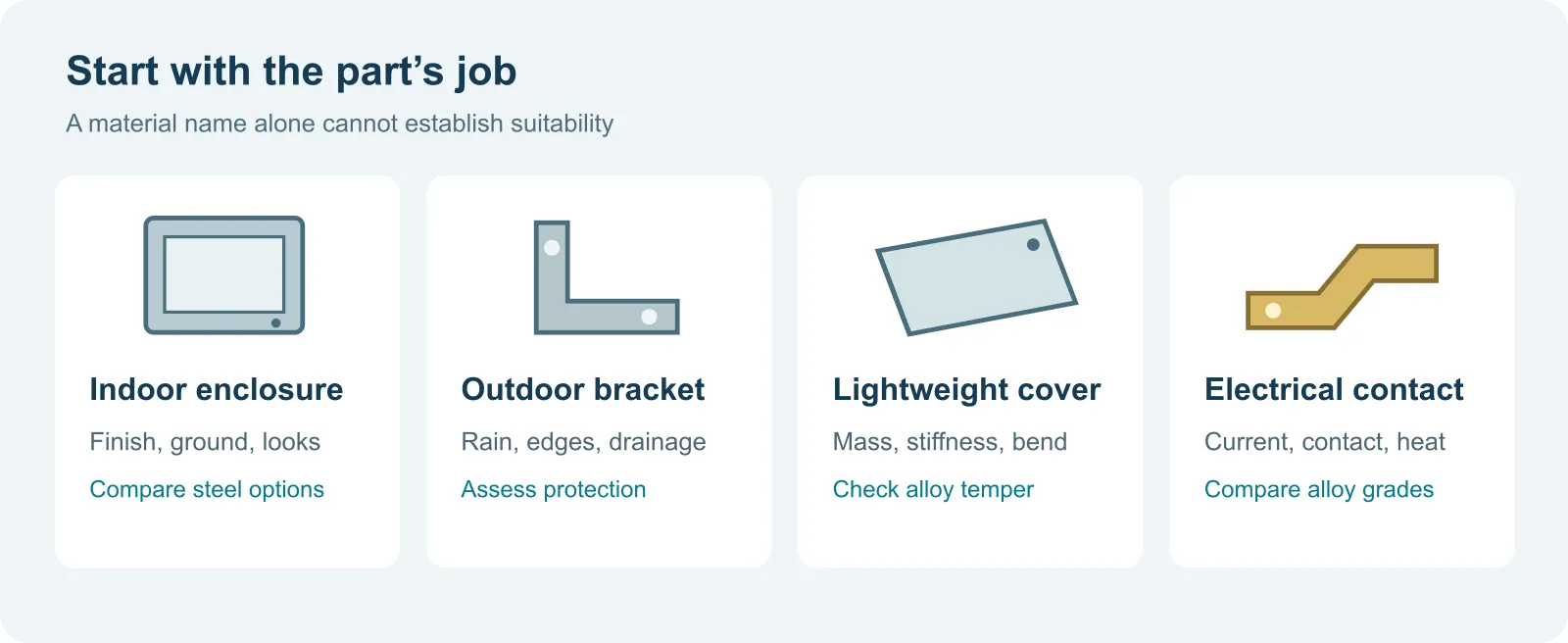
- Indoor painted enclosure: compare SPCC plus finishing with pre-coated sheet as complete finished-part options, including grounding, edges and appearance.
- Outdoor bracket: describe rain, trapped water, proximity to salt and maintenance before comparing the material, zinc coating and edge protection.
- Lightweight cover: consider 5052, then validate stiffness, bending, assembly and the required appearance.
- Electrical contact: describe the current path, connection and allowable temperature rise before comparing specific alloys.
What to put on the drawing or RFQ
When the material is selected, state the grade and product standard, condition or temper, nominal thickness and permissible substitutions. For coated sheet, include the coating designation and surface requirements. Mark bends, joints, grounding and cosmetic or contact surfaces where they matter.
If the grade is still undecided, start with a drawing, sketch or photograph and describe the use, environment, expected quantity and open questions. Compare proposals on the same scope of material, finish, inspection and delivery.